

A better way to measure creator marketing success


Creator marketing has changed. The way most brands measure it hasn’t.
Since the early days of influencer marketing, brands have typically treated creators as an extra layer of distribution. Build the campaign, hand over the brief, buy some posts, report on reach, and repeat. Like most of marketing’s traditional playbooks, that model isn’t working like it used to.
In 2026, creators are not an add-on to your media plan. They are the media plan: a core channel for building attention, shaping perception, testing ideas, and driving action. They sit somewhere between media partner, creative agency, cultural translator, and conversion engine.
But while the role of creators has evolved, the way brands evaluate them has largely stayed the same. Views, reach, and likes are all metrics designed for a different era of social, applied to a channel that now plays a much more complex role.
That gap is starting to show. As more brands invest in influencer marketing, and top creators even reach mainstream celebrity status, feeds are more crowded, and attention is harder to earn. Surface-level metrics are becoming less useful for understanding what is actually working and what (and who) is worth investing in.
In this era of influence, the challenge for brands isn’t realizing value from creator impact. It’s a lack of clarity on how to measure it.
From measuring volume to quantifying value
If your brand is measuring creator performance the same way it did five years ago, via reach, impressions, and engagement rate, you aren’t getting a fully accurate picture.
Traditional engagement rates treat every action as equal. The same amount of value is attributed to a like, save, comment, and share, even though they reflect considerably different levels of intent.
A like is passive, while a save suggests future interest. A comment requires more effort, but a share is often the strongest signal of all because someone is willing to put the content in front of their own audience. There is a clear hierarchy to engagement, and the more effort an action requires, the more it tends to say about how the content is landing.
That is why teams at DEPT® are moving toward a weighted approach to measurement. Rather than rewarding volume alone, weighted engagement gives more value to the actions that signal stronger intent and greater advocacy.
Some teams formalize this by creating a simple scoring model that assigns greater weight to higher-intent actions. For example, shares might be valued more heavily than comments, comments more than saves, and saves more than likes—reflecting the increasing level of effort and intent behind each interaction.
The exact weights will vary depending on your brand, category, and objectives. The point is the principle behind the formula: not all engagement carries the same value.
In practice, that shift can completely change how performance is evaluated.
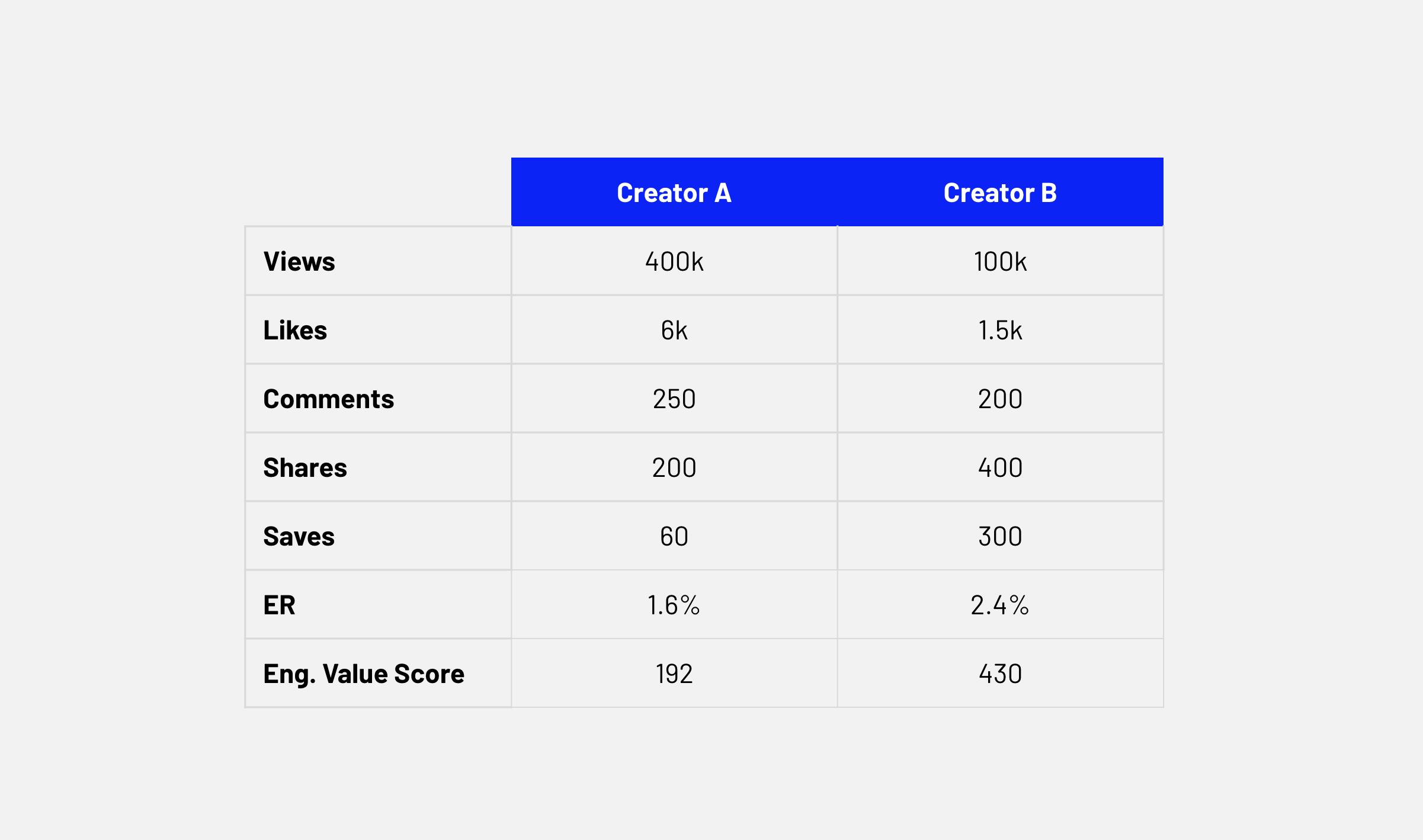
In a recent campaign with a global brand, we saw this dynamic play out clearly. Two creators delivered content within the same campaign, and based on engagement rate alone, Creator B appeared only slightly more engaging than Creator A.
But when we looked at the type of engagement each drove, the difference was clear. Creator B generated significantly more shares and saves, resulting in more than 2.5x meaningful engagement per view. That shift in perspective directly influenced which content was amplified, which creator the brand reinvested in, and how future briefs were shaped.
Different roles, different ways to measure value
Not all creators serve the same marketing objective, but most brands still measure them as if they are.
A creator brought in to drive awareness during a product launch is being asked to do something different from helping a new idea land with a skeptical audience, yet they’re often evaluated through the same lens. That’s where performance starts to get misread.
Traditional engagement rate flattens everything, treating every interaction as equal and every creator as interchangeable, regardless of what they were actually meant to deliver. As a result, brands end up optimizing for the most visible signals rather than the most meaningful ones.
Once you recognize that creators play different roles, the logic becomes straightforward: the signals you use to evaluate them should reflect the job they were brought in to do.
In reach-led partnerships, scale and efficiency still matter. If the goal is visibility, then impressions and cost per reach are relevant signals. But as soon as the objective shifts toward influence—whether that’s credibility, learning, or long-term brand building—those surface-level metrics start to fall short, making a weighted view of engagement more useful.
Instead of asking which creator generated the most interactions overall, you start to look at the type of interactions they generate relative to their role. A credibility-led creator who drives a high volume of saves, comments, and shares may be far more valuable than a reach-led creator generating large volumes of likes. A content partner producing dozens of assets may be less about individual post performance and more about which pieces consistently trigger stronger, higher-intent responses.
The shift is subtle but important. You’re no longer evaluating creators against a single benchmark. You’re evaluating them against the outcome they were meant to deliver—and using the right signals to judge whether they did.
From cultural signals to business impact
The most effective creator strategies generate signals. Every save, share, comment, and piece of creator-led content tells brands something about what is resonating, which messages are landing, and which ideas deserve more investment.
Savvy teams use those signals to make smarter decisions across the rest of the media mix: which content to amplify, which creators to deepen relationships with, and which stories are worth building into larger campaigns.
The brands that will get the most value from creator marketing in 2026 and beyond won’t be chasing the biggest names or the most impressions. They’ll earn that value by building systems that allow them to identify the right creator partnerships, deliver the most impactful content, and understand and leverage the signals that matter.