

Why AI has yet to lead to a measurable increase in corporate productivity


Everyone expected a breakthrough. Instead, we got a plateau.
Three years into the AI boom, companies are starting to ask a tougher question: Where are the results?
Billions have been invested. AI has been deployed across industries at great cost. And yet, productivity hasn’t meaningfully improved. How can it when AI is bolted on to old ways of working? In many cases, it just feels faster, but not better.
The mood is starting to shift. The early excitement is giving way to disappointment, uncertainty, and even anxiety. But the issue isn’t the technology itself. It’s the way we’ve chosen to think about it.
Most companies are still treating AI as the next generation of automation: a tool that can take on a clearly defined task and do it faster, more cheaply, and at greater scale.
But that framing misses the point. AI doesn’t just execute. It interprets, generates, recommends, and increasingly participates in the work itself. And when you treat something participatory as if it were purely mechanical, you run into a subtle but important problem: you optimize the activity while quietly undermining the outcome.
At the heart of that problem are two things most companies still aren’t accounting for well enough.
- Context
- Empathy
The difference between faster activity & better outcomes
In one pilot, we deployed an AI agent to help employees navigate a return-to-office policy.
During testing, an employee asked whether staying home could get them fired. The system searched the employee handbook and responded: “Only if you get violent.”
While this is technically accurate, it’s organizationally disastrous.
Because the employee wasn’t really asking for a literal interpretation of policy. They were asking something much more human: How serious is this? Am I at risk? What should I do?
A manager would have understood that instantly. The AI didn’t, because it wasn’t built to read the room.
What the agent lacked wasn’t intelligence, but empathy. AI can process enormous amounts of information at speed. But it still struggles with situational nuance. That makes it incredibly useful in environments where the goal is to find a fixed, objective answer. It makes it much less reliable when the “right” answer depends on tone, context, intent, or emotion.
Lessons from Klarna: The high cost of removing the human element
The same dynamic showed up publicly at Klarna.
In February 2024, CEO Sebastian Siemiatkowski said that 80% of Klarna’s customer support would be handled by AI. Less than a year later, he changed course, saying Klarna wanted to become “the best at offering a human to speak to.”
To Klarna’s credit, it recognized something many organizations still haven’t: intelligence alone doesn’t make AI effective in human-centered work.
And the missing piece isn’t empathy in a soft, sentimental sense. It’s empathy in a functional sense: the ability to understand what someone actually needs, not just respond to the words they used.
That distinction turns out to be one of the biggest fault lines in how companies are deploying AI today.
Too many assume correctness is enough. But in much of modern work, correctness is just the starting point. What determines the outcome is context, judgment, and the ability to navigate human dynamics.
The empathy question companies aren’t asking
To get real value from AI, you need a different lens. Not a checklist of tasks to automate, but a way to understand the conditions that make work succeed or fail.
Two questions can take you surprisingly far.
First: Does empathy improve the outcome, or degrade it?
In data collection, human subjectivity introduces bias. You want the machine. In converting that data into insight, human subjectivity creates meaning. You need the person. Empathy is not uniformly good or bad; it depends on what you are trying to produce.
Second: Is correctness defined by fixed rules, or by context?
The tax calculation has the correct answer in the documentation. A client negotiation has the right answer in the room. These are fundamentally different problems requiring fundamentally different kinds of intelligence.
Plot those two dimensions together, and four quadrants emerge.
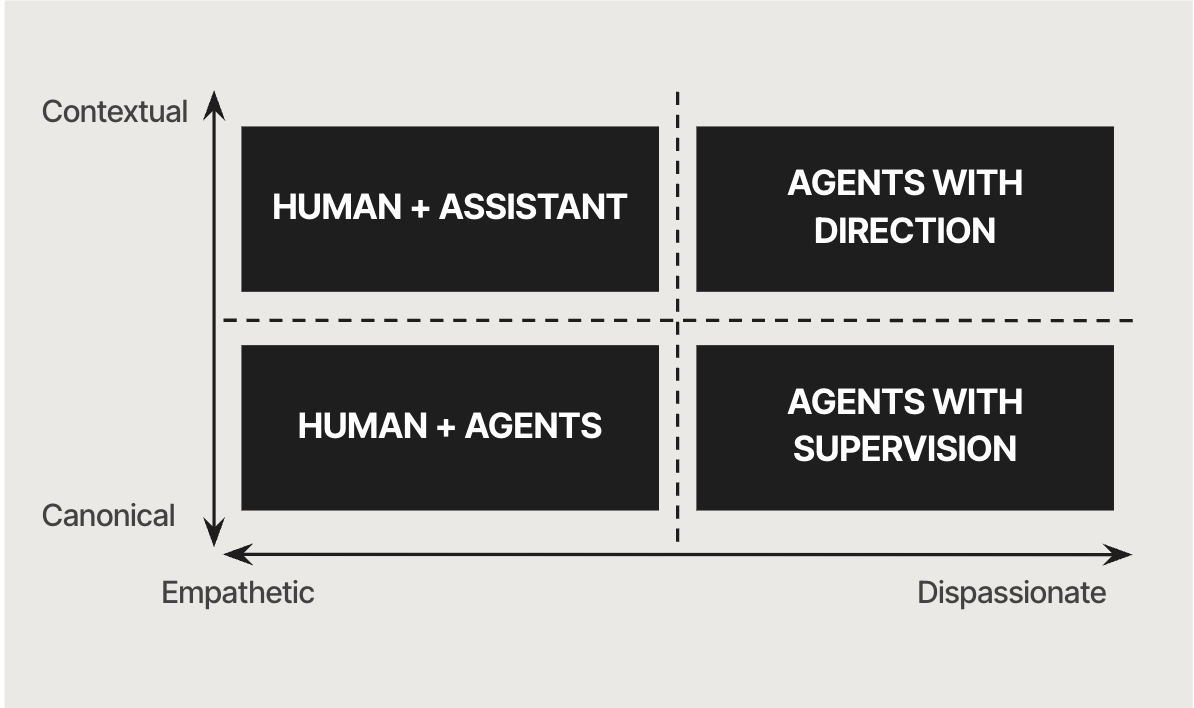
Empathetic-Contextual: The human leads, with AI in a supporting role. This is the right model for work that depends on judgment, nuance, and changing circumstances, where AI can assist across tasks and projects but shouldn’t act independently.
Empathetic-Canonical: The human still leads, but AI can take on more structured supporting tasks. In writing, for example, AI can pull in relevant information, check grammar, and review work against brand or compliance guidelines.
Dispassionate-Canonical: These are structured, rules-based tasks where AI should do most of the work, with humans providing oversight. Data collection and aggregation are good examples.
Dispassionate-Contextual: This work benefits from some emotional distance, but still depends heavily on context. In these cases, AI can help move the process along, but it should operate under human direction. Interviews are a good example.
The real cost of getting this wrong
The companies that will create real value from AI won’t be the ones that deploy it the fastest. They’ll be the ones who understand where empathy shapes outcomes and design accordingly.
That means being deliberate about where AI should replace human effort, where it should support human judgment, and where it should stay out of the way entirely.
Because AI is not just automation.
It’s better understood as augmentation: a capability that can support people directly, or in some cases take full ownership of a task, but only when the surrounding workflow has been designed with that balance in mind.
Right now, many organizations are investing heavily in AI while underinvesting in the people expected to work alongside it. They’re inserting the technology into isolated tasks without rethinking the broader workflow or the human-AI relationship inside it.
That’s a big reason productivity hasn’t moved.
There’s also a temptation to think the answer is simply to make AI more empathetic — to train it to sound more human, respond more naturally, simulate understanding more convincingly.
That may help, but it’s only part of the solution.
The bigger opportunity is to design systems that account for empathy rather than pretending it can be fully automated. Systems where human judgment shows up at the moments that matter most, and where AI is used to enhance that judgment rather than replace it.