

The AI-impact gap: Why the industry is incentivized to ignore the real numbers


AI’s profits need to be aligned with your company’s purpose.
Almost a year since an MIT Nanda study found that only 5% of organizations piloting AI solutions have gone on to adopt the emerging tech in their workflows, and more than a year since Sam Altman declared that 95% of advertising work can be done by AI, we find ourselves in a disconnect between what is pushing the proliferation of the technology, and what drives the growth of organizations faced with the Principal-Agent Problem.
The extent to which this disconnect has sharply led to disillusionment can be anecdotally illustrated by the CEO of Klarna who claimed that 80% of customer support would be handled by AI agents in February of 2024, followed by an about-face just one year later whereby Klarna would connect you to a human. A note on this example is how impressed I am with a leader that not only experiments, but is not afraid to reverse course based on the data.
This gives us a few anecdotal data points to a pattern where AI sellers use hyperbolic numbers that show AI taking over all the work, “motivated” CEOs of early adoption companies that use figures justifying the spend to increase company value, “opportunistic” CEOs using high AI impact forecasts to justify their need to cut costs, and actual employees seeing conflicting results almost weekly while grappling with the prospect of tech adoption contributing to their replacement strategy.
Who should you believe? The simplified answer is the people motivated to tell you the truth, not the ones trying to sell you something that depends on stretching that truth. In the last quarter of 2025, the National Bureau of Economic Research (NBER) surveyed leaders in companies across industries in four leading economies (USA, UK, Germany, and Australia), concluding that 90% found low or no impact on productivity over the past 3 years, despite bandwagon adoption programs. NBER’s findings, published last month, also included a modest forecast of impact on productivity (1.4%) over the next three years by those surveyed, a far cry from “AI can do 95% of the work” touted by people looking to sell us AI.
We are investing in the wrong place
In trying to understand why expectations are not being met, common reasoning points to AI being overhyped or less impactful than promised.
While hyping up the tech is a hallmark of AI providers motivated by fundraising, the problem for companies adopting the tech isn’t that AI is not good enough, but that we are not reorganizing our talent and processes to take advantage of a new tech that can deliver gains. Instead of focusing on the creation of value that aligns with a company’s purpose, “productivity” is measured by how much output can be achieved with a smaller workforce.
Disappointing results over the past three years, paired with muted forecasts, point to the problem not being one of technological capability or intelligence, but rather a flawed strategy motivated by profit for its own sake.
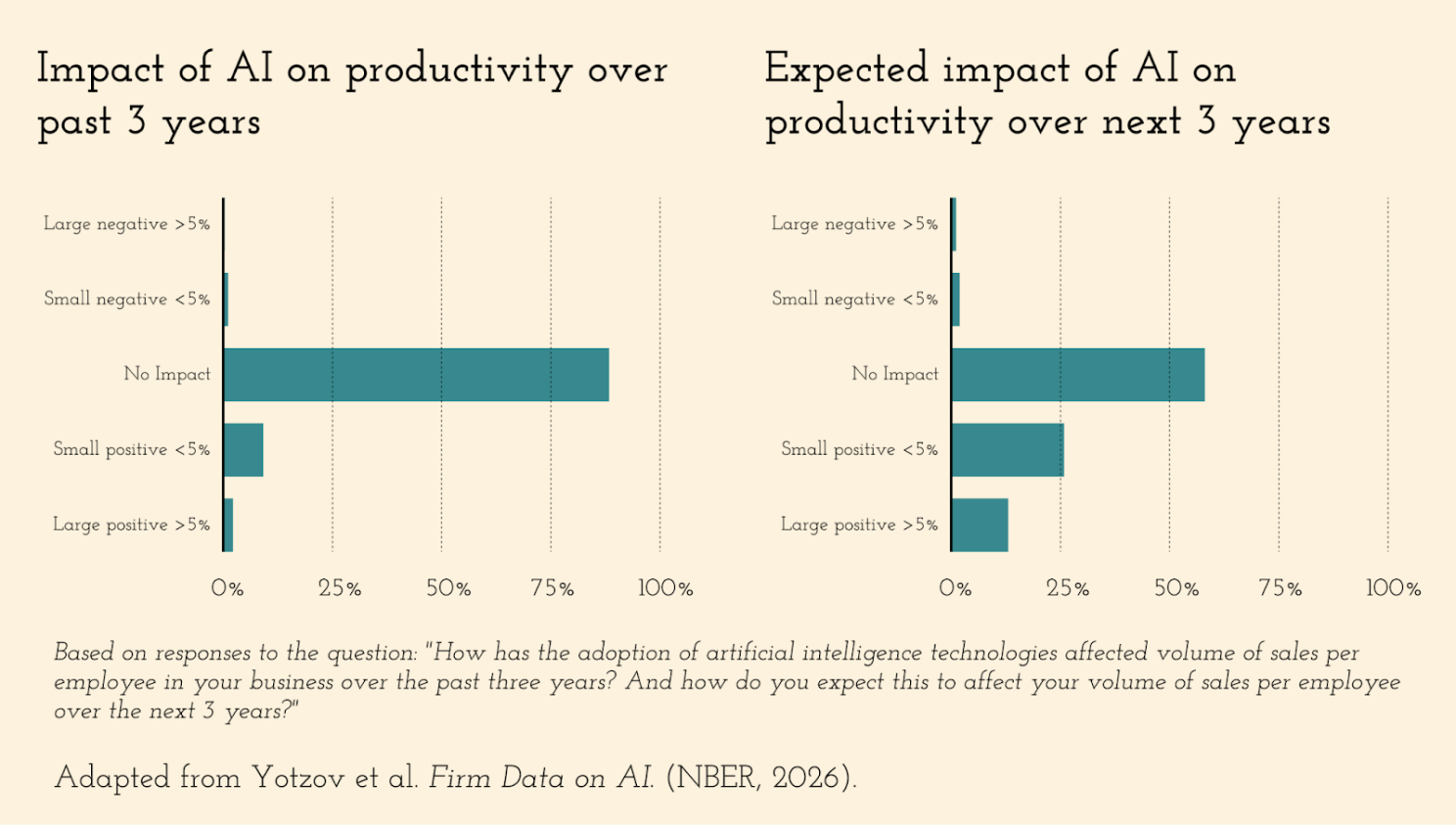
Apply that problem to the field of sales and marketing, an area where both MIT and NBER’s research shows the highest expectations of AI impact, and the motivational misalignment becomes clear.
A CMO’s priority is to apply AI that enables growth and profitability. Growth in this context can be achieved by being more effective at what they are already doing, by finding new areas of potential value, or by being more profitable by doing both more efficiently.
A tech company’s priority is to sell tech. Yes, their idealized goal is for their tech to help a CMO with growth, but that takes a back seat (pun intended for all you seat-based vendors) to selling their tech, regardless of what it is used for.
An ad agency’s priority is to sell time (or media). Again, their ultimate goal is for their tech to help a CMO with growth, but unless their revenue is linked to the outcomes (the growth), their motivation will follow their revenue. The same goes for consultants dependent on billable hours.
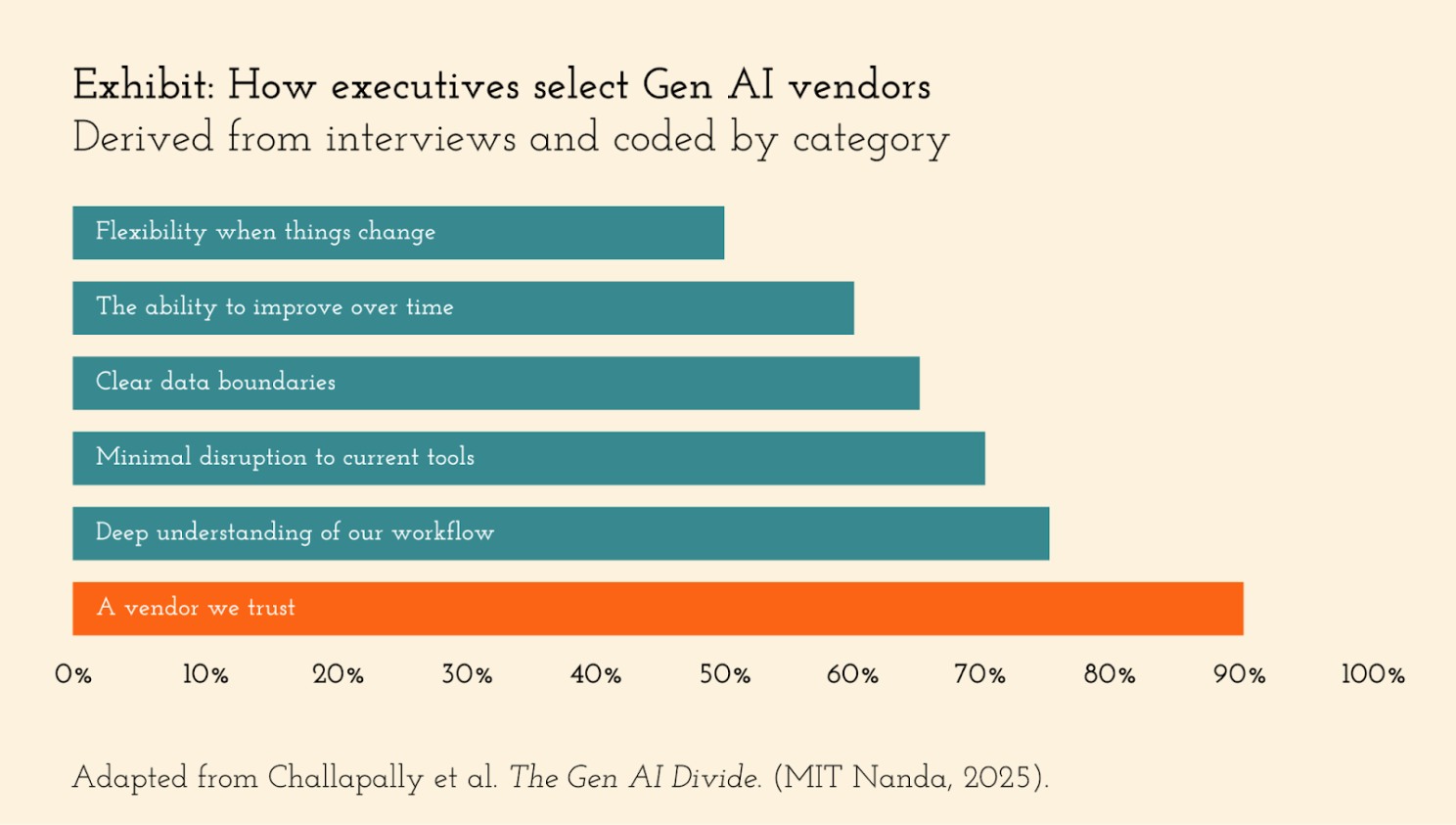
The principal-agent problem
That leaves a whole lot of grey area to navigate, especially when consulting firms and agencies send mixed signals. Let’s take the announcement by WPP recently.
Are they looking to charge for outcomes or for the use of their tech?
Their press release says outcomes, but their hundreds of millions in tech investment and launch of an OpenPro where they charge for tech indicates otherwise. The same can be said for Publicis, with a higher leaning towards the data and media sales side on commission, or any peer agency. It is in this grey area that the principal-agent problem manifests.
The agent claiming to charge for outcomes but charging the principal for access to proprietary tech creates tension inherent to a strategic conflict that serves:
- Information asymmetry: By keeping the AI’s inner workings hidden, the agency maintains a monopoly on expertise, hindering the brand from achieving the mastery required to achieve its purpose.
- Monetizing friction: If a brand does not understand how the “black box” achieves its outcomes, they remain dependent on the agency to operate it. This allows the agency to continue charging for “usage” or “seats” rather than the principal’s purpose of growth.
- Selling “wrappers”: Agencies become vendors of SaaS features being touted as transformational AI, but are actually raw models provided by AI tech sellers without the workflow redesign that would fit the brand’s purpose.
Start by asking the right questions
The best way to navigate the grey area is by following the money. Who is investing in AI with growth in mind? Who is working on their commercial model so that it benefits from your growth rather than your usage? Who is focused on your team’s development and readiness to utilize AI before they talk about selling you tech that will not get past pilot-purgatory?
I don’t have an answer to these questions, nor should you trust my motives if I did. I work at agencies, I consult, and I advise startups that sell you both data and tech. Instead, I suggest you follow a framework that helps you view AI through a lens that benefits you, not AI sellers. I will save that for another article and not dilute your thinking for the time being.
Finding a solution brings us back to motivation. How do you identify who is motivated to help you grow? The answer would benefit from the perspective of two psychologists, Daniel Pink and Victor Vroom.
Pink tells us that motivation depends on the profit motive being aligned with the purpose motive. If you find purpose in enabling growth and profit from it, you will be motivated to enable growth.
However, if your purpose is to enable growth and you profit from selling tech, then your profit is “unmoored” from your purpose. Business organizations might have a purpose, but they are profit-driven. At best, they will achieve the profit at the cost of the purpose (your growth), and at worst, they will achieve neither.
Vroom, through his Motivation Expectancy Theory, tells us that motivation is based on 3 factors: Expectancy, Instrumentality, and Valence. In other words: “Can I do it?” “Will I get rewarded?”, and “Do I like the reward?” The client perspective on this is:
- “Can I utilize AI?”
- “Will I receive a benefit from that utilization?”
- “Does that benefit align with my company’s priorities or purpose?”
If the benefit is growth, then the last part of the equation works in your favor, and what remains is the ability to apply the AI: a step that is highly dependent on finding partners that are motivated in a similar manner. The last thing you want is their equation to be “Can I sell AI?”, “Will I receive a reward for selling AI?”, and “Do I like the bonus we get by selling AI?”.
Klarna’s about-face on AI is an example of a company whose profit motive was unmoored from their purpose motive, and quickly realizing the misalignment of their “over-pivot”, to use their CEO’s words.
By falling into the profit trap, Klarna sought to replace workers to save money while reducing resolution time (in their case, substantially, from 11 minutes to 2). They invested in tech to reduce costs, assuming their purpose (customer satisfaction and trust) would remain stable.
A year later brought the admission that the “quality” of human connection was missing from complex cases: When a financial transaction goes wrong, a customer doesn’t want a 2-minute resolution from a bot when an 11-minute resolution by an empathetic human who helps fix a life-impacting problem.
In Klarna’s case, a misalignment of motives hindered their “mastery” of the customer relationship, and human agents had to be rehired to handle the moments that matter.
Resolution
You need to find partners whose profit motive aligns with your purpose, so the reward is shared. Their motivation equation needs to have their reward attached to your growth. Here is what that should look like in terms of priorities, which should feel like a summary of what is above:
- A partner is motivated to help your team develop and be AI-ready before recommending tech that will be ignored.
- A partner is ready to change their commercial model to align their rewards to your growth. I know that’s hard for CMOs too, so even figuring this part out is a partnership.
- A partner invests in tech that enables them to help you grow, not in tech they’re looking to sell.
- A partner works with you on understanding how to apply AI to the way that you work, then helps you evolve the way you work to fit the age of AI.
- A partner shares your motivations.
This list obviously isn’t a revelation, nor is it comprehensive, but you don’t really need a list. Figuring things out comes down to applying the motivational lens.