

DEPT® brings growth invention to the Webby shortlists


The Oscars of the Internet are back, and we’re celebrating the incredible work our teams have achieved over the past year.
The 30th Annual Webby Awards just announced their nominees, and DEPT® has snagged a massive 20 nominations across the board.
From cutting-edge AI experiments to digital experiences that actually make the world a bit better, our work this year spans the full spectrum of what’s possible online. We’re incredibly proud to see our collaborations with brands like Google and Lululemon recognized by the International Academy of Digital Arts and Sciences (IADAS).
Where we’re trending
This year’s shortlists highlight exactly what we love doing: pushing the boundaries of technology without losing the human touch. Our nominations land in some of the most competitive categories, including Advertising, Media & PR, Website & mobile sites, and AI.
“This kind of work only happens when you really understand what clients are trying to achieve. Growth invention is our way of bringing creativity, technology and data together to make that happen. We’re proud to see it recognised like this.
”Marjan Straathof, Global SVP of Marketing
Help us take home the People’s Voice
While the official Webby Winners are chosen by the Academy, the People’s Voice Awards are entirely up to you. Voting is officially open, and every single click counts. We’d love your support in bringing these trophies home.
Cast your votes for DEPT® below:
NVIDIA / American Society for Deaf Children
Signs
Accessibility & Inclusion
Responsible Innovation
Accessible Technology
Mammut
Give Mountainwear the life it deserves
Brand Strategy
Fashion, Beauty & Retail
Google
Antigravity
Business Blog / Website
Netflix
Netflix Ads
Best Navigation / Structure
lululemon
Fashion, Style & Beauty
Shopping & Retail
Google
Google Store
Best Mobile Visual Design – Function
Features & Design | Best User Interface
Best Mobile User Experience
Talking Portraits
Arts, Fashion & Culture
Arts, Culture & Events
Creativity & Storytelling
Best Real-Time Engagement
Otrium
Otrium Ovatars
E-commerce & Retail
Docusign
Best Practices
Uber Eats (In partnership with Special US )
Best Use of Video or Moving Image
Best Copywriting
Voting closes on Thursday, April 16th, so don’t wait!
Congrats to all of our amazing clients and talented teams up for a win, and thank you for voting!
Honorees
Finally, congrats to all our honorees. These projects ranked in the top 25% of entries but just missed the nomination list.
BUUT in the Apps, Software & Immersive – Kids & Family Category.
Netflix Ads in the Websites & Mobile Sites – Best Responsive/Adaptive Design for Mobile Category.
Nikon in the Websites & Mobile Sites – Best User Experience Category.
Otrium Ovatars in the AI – Best Responsible AI Implementation Category.
Reclaiming Our Atlantic Destiny in the Websites & Mobile Sites – Charitable & Non-Profit: National & Global Organizations Category.
Turning snack dust into street cred for Cheetos UK in the Advertising, Media & PR – Social Media Campaign Category.

Why enterprise teams are drowning in SaaS, but still struggling to scale


Over the last decade, enterprise marketing teams did exactly what the market encouraged them to do: they bought software.
A platform for workflow. One for content. A few more for analytics. One for DAM. Another for personalization. Then another layer to connect them all. And on and on.
At the time, that made sense. Growth was easier to find, budgets were more flexible, and the priority was often expansion at speed. But the decade ahead looks very different. Slower growth, aging populations, and structural disruption are creating headwinds for brands, forcing them to work harder than ever for every point of growth.
In that context, the challenge is no longer access to a capability. Most enterprises already have plenty of that. The challenge is turning capability into performance.
In other words, the real problem isn’t access — it’s getting the technology you already have to actually work. And in an accelerated, AI-powered environment, that gap is getting harder to ignore.
51% of SaaS licenses go unused
According to Zylo’s 2025 SaaS Management Index, 51% of enterprise SaaS licenses go unused, with an average of $18 million wasted annually. BetterCloud reports that organizations use 100+ apps, many of them unsanctioned.
The result is overlapping tools, inconsistent adoption, siloed ownership, unclear accountability, and teams forced to work around the stack instead of through it.
Enterprise leaders still frame this as a build vs. buy decision. But for most organizations, that question has already been answered. They’ve bought plenty.
The more important question now is: how do you get more value from what you already have?
The next advantage is operational, not technical
The next competitive advantage won’t come from adding more tools. It will come from building the operational layer that connects your platforms, teams, and workflows into something that actually performs.
That means:
- Visibility into what’s being used and what isn’t
- Clear ownership and governance
- Integration that reflects how teams actually work – not how vendors think they should
Most of all, it means shifting the mindset from acquisition to performance.
Gartner estimates that organizations that fail to centralize SaaS visibility will overspend by at least 25% through 2027. But the higher cost isn’t just waste – it’s the opportunity lost through poor coordination.
AI will amplify whatever system is already in place
AI is making it easier than ever to generate, adapt, and distribute. But speed is only valuable if the underlying system is sound.
If your workflows are fragmented, AI will not solve that–it will expose it.
If your stack is disconnected, AI will not unify it. It will accelerate the mess.
If teams do not know where work lives, which tools matter, or how decisions are made, adding AI to the environment will only increase output volume without increasing its value.
And that matters, because the promise of AI is better amplification.
At its best, AI should be in the service of human ingenuity, helping teams surface better insights, move through executional friction faster, and spend more energy where it matters most: on ideas, craft, and creative differentiation. In a world at risk of becoming more automated and more uniform, it’s essential to do something interesting.
That is why the real priority is making the system work.
For brands modernizing content operations, it means building a clearer operating model around the capabilities already in place: which tools matter, how they connect, who owns them, and where automation genuinely improves outcomes.
So what does a better model actually look like?
The answer is not to add another platform to an already crowded stack. It is to build an operating model that makes your existing stack perform. That means identifying where outcomes are created, where friction slows teams down, and where the right mix of people, AI, and technology can improve the system end-to-end.
In practice, that looks less like buying a single AI solution and more like enabling the full workflow: connecting planning, production, activation, measurement, and optimization; giving teams contextual AI support inside the way they already work; automating repeatable tasks where speed matters; and building the governance, training, and orchestration layer that turns isolated tools into a coordinated system.
Not AI for its own sake, but better performance from the capabilities already in place: faster delivery, stronger quality control, more relevant personalization, clearer accountability, and a model that can scale without creating more operational drag.
That is the shift from abundance to activation
The SaaS era gave companies more capabilities than ever. But capability on paper is not capability in practice.
If half your licenses are underused, if your stack is sprawling, and if your teams are still working around the tools instead of through them, then the issue is not whether you need more software. It is whether you have built the conditions for software to work.
That is the opportunity for enterprise leaders now.
Not to rip everything out. Or to buy one more silver bullet.
But to operationalize the stack they already have, and turn a patchwork of tools into a system that delivers. Because the strongest systems do not just create better business performance; they create better conditions for people to grow — building the kind of cross-functional, cross-platform thinking that matters far more than fluency in any single proprietary tool.


DEPT® appoints Roy Armale as Chief Product Officer to scale its growth invention model

DEPT®, the Growth Invention Company, today announced the appointment of Roy Armale as Chief Product Officer, effective April 2, 2026.
Armale joins from WPP, where he served as Chief Product & Growth Officer at WPP Open, the network’s AI-based operating system for marketing, and brings more than 15 years of experience making technology work in the service of people and growth.
Armale’s appointment is the latest sign that DEPT® is competing for and winning the talent that will define the future of this industry and who shares its belief that AI creates growth only when it amplifies people, not when it replaces them.
The company recently launched DEPT® Studios, an enterprise content operating system powered by Adobe.
Globally, DEPT® already generates 50% of its revenue from AI-enabled services and manages more than $5 billion in digital media spend, up 25% year over year, across global brands including Logitech, OpenAI, and eBay.
Armale joins to take that momentum further, leading the product vision and technology capabilities that power DEPT®’s growth for clients. With over 15 years of experience at Geometry Global, VMLY&R Commerce, and the WPP CTO Council, Armale built a reputation for one thing: making technology work in the service of people and growth, not the other way around. He holds a postgraduate degree in Artificial Intelligence for Business from Saïd Business School, University of Oxford.
“Growth today requires a unifying system that connects marketing, engineering, data, and human creativity. Roy understands how to build that layer. He has consistently proven that technology creates value only when it is embedded in how people work. That belief is fundamental to Growth Invention, and it’s why he’s the right leader for this next phase.
”Dimi Albers, Global CEO at DEPT®
Armale will lead DEPT®’s Future of Work program, scaling the people development model and AI capabilities the firm has already built for the age of AI.
Central to this is the company’s AI-powered platform that connects best-in-class partners, including Google and Adobe, across the full customer journey, enabling teams to identify growth opportunities faster and act on them with greater precision.
He will also advance DEPT®’s Empathy Gradient framework, which ensures technology amplifies rather than replaces human expertise.
“The industry is distracted by AI as a headline. But AI alone does not create growth. Growth happens when technology augments people, removes friction between disciplines, and aligns with a clear commercial purpose. DEPT® is not building AI for efficiency; we are building systems for growth. That difference matters, and it’s why I’m here.
”Roy Armale, Chief Product Officer at DEPT®

Why great commerce experiences start with better content


You’re probably sitting on powerful commerce infrastructure.
Your cart works. Checkout is fast. Promotions are automated. Inventory is accurate.
And yet the experience feels thin.
That’s usually because commerce has been treated as the main event, while content has been left to support from the sidelines. But customers don’t arrive ready to transact. They arrive with questions, hesitation, curiosity, and competing options. What helps them move forward is not just the platform underneath the site. It’s the experience wrapped around it. And that experience is shaped by content.
Commerce platforms are very good at helping people buy. They are not designed to do all the work of helping people understand, trust, compare, imagine, and decide. That gap is where many brands struggle. The stack may be technically sound, but if the content layer is weak, disconnected, or hard to manage, the overall experience starts to feel functional rather than compelling.
That’s the real issue: a commerce stack can process demand, but it can’t create it on its own.
Content connects discovery & conversion
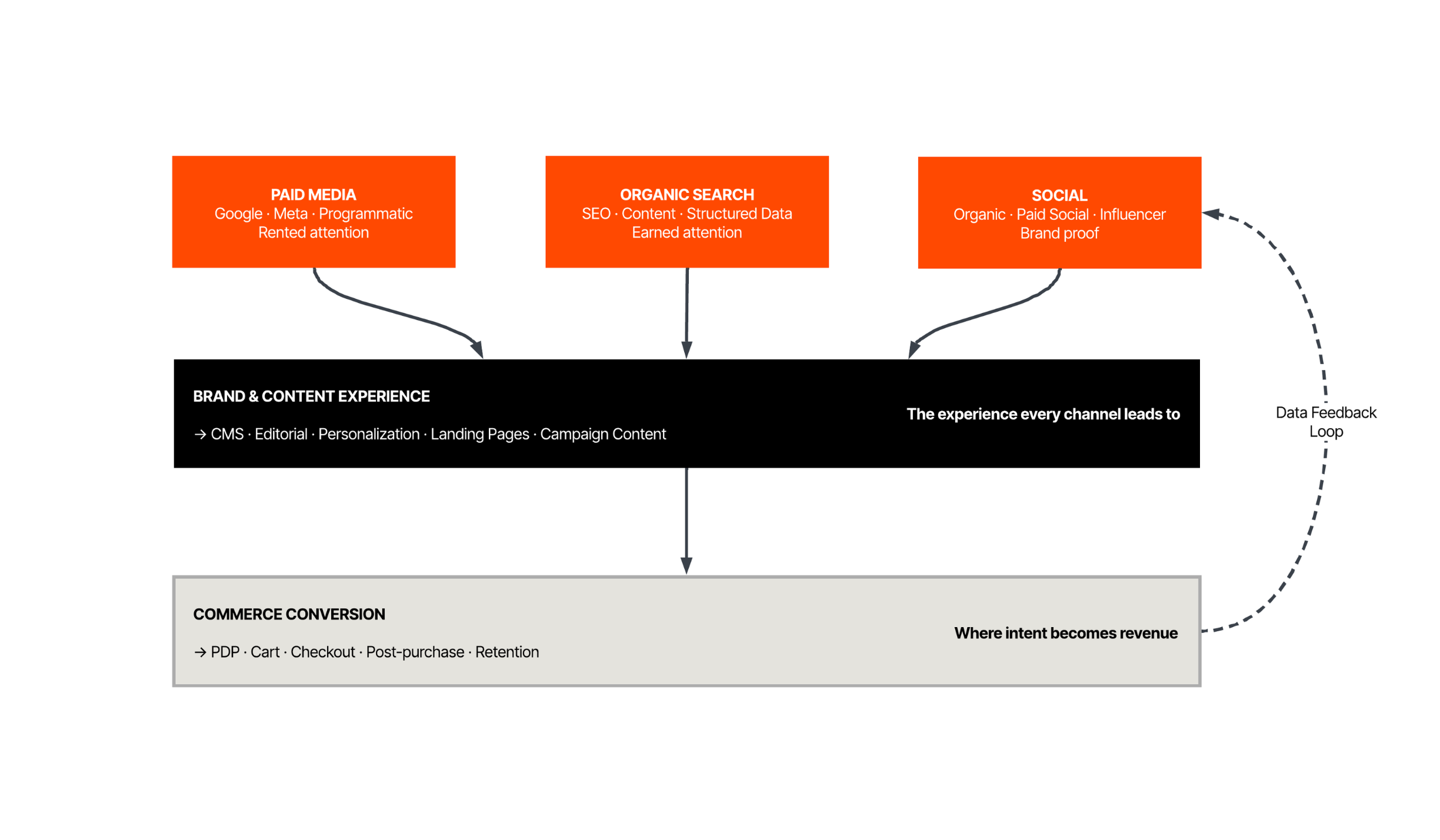
Content does more than support the on-site experience. It also shapes what happens before someone ever arrives.
Paid media, search, and social may drive discovery, but they only work as well as the experience they lead to. A weak landing page, thin editorial support, or disconnected campaign message makes acquisition less efficient from the start. Strong content improves on-site engagement and helps every channel work harder.
That matters because customers do not move through digital experiences in neat organizational paths. They might discover your brand through paid media, compare options through search, build trust through editorial content, and convert through the commerce experience. To them, it is one journey. If the content across those moments feels inconsistent, generic, or hard to manage, the gaps start to show.
That is why content, commerce, and channel strategy should not be treated as separate systems. Content is the connective layer between discovery, consideration, and conversion.
The CMS may not be the problem, but the implementation often is
Many teams come away from CMS projects frustrated. They choose a respected platform like Contentful, Contentstack, or Adobe, but the result still disappoints. Editors struggle to use it. Developers become the bottleneck for simple changes. Publishing takes too long. Campaign content gets hardcoded. Everyone feels the friction.
But the uncomfortable truth is the platform is almost never the problem. The problem is the implementation. Specifically, a content model designed by developers, for developers, that treats editors as if they’re filing tickets rather than crafting experiences.
A strong CMS architecture usually starts with questions that have very little to do with technology:
- How does the editorial team think about content?
- What does that content need to do across channels?
- How should data influence what gets shown, and when?
Those answers should shape the implementation, not the other way around.
A practical CMS framework
Sequenced discovery before a single line of implementation code is written.
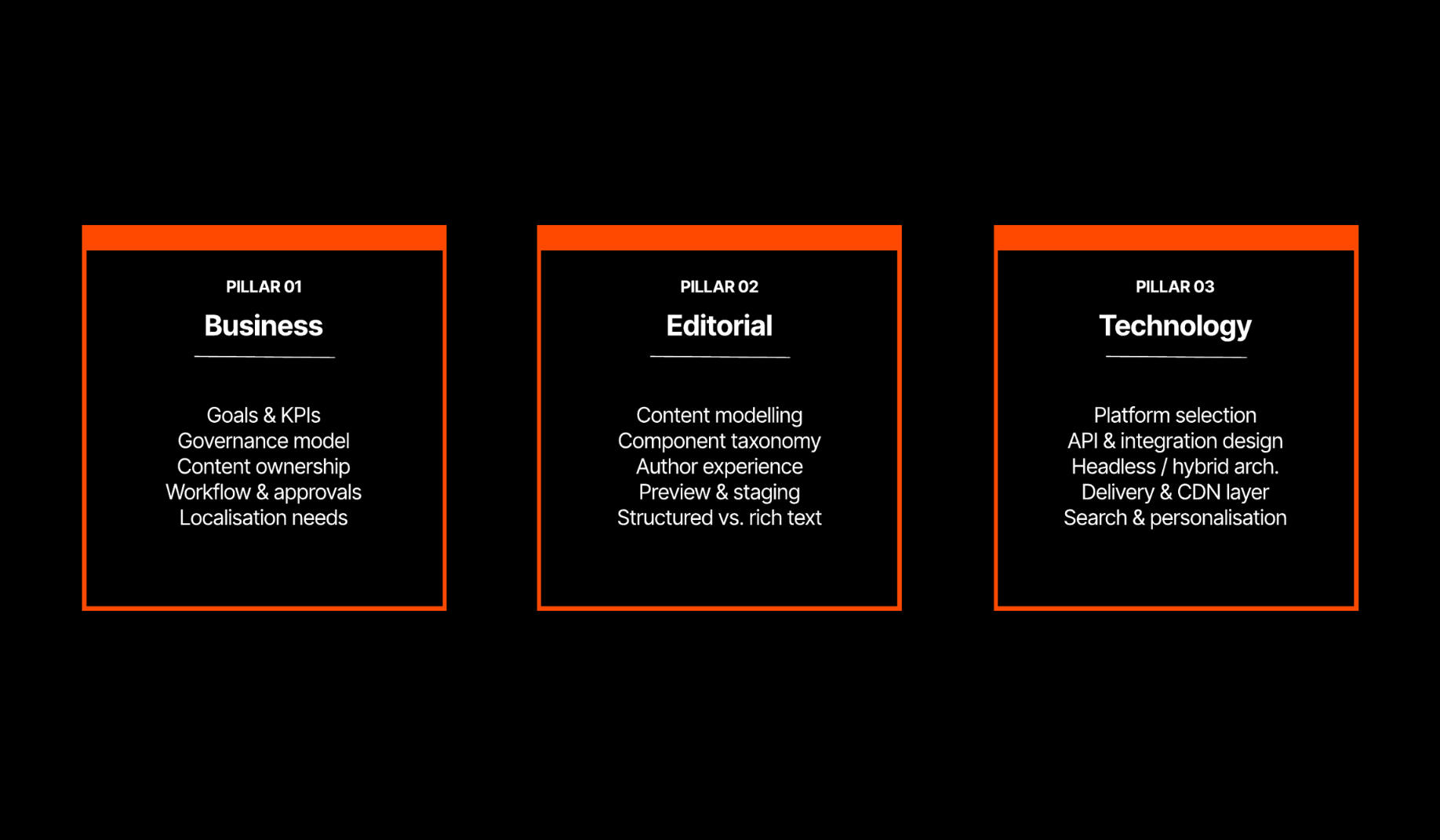
The most common mistake in CMS implementations is letting the platform’s “getting started” guide become the content model.
It may help a team get moving quickly, but it rarely reflects how brand teams work, how governance functions, or how content needs to scale over time.
That’s why content modeling is one of the most important design decisions in the stack. It shapes not only what gets published, but also how easily teams can adapt later.
The personalization gap: Data, signals, and relevance at scale
Almost every brand says it wants personalization. Many already have a CDP, or at least access to one. Some have run homepage tests or built audience segments. But far fewer have connected those signals to the content that actually gets rendered on the site.
That gap is common.
The challenge is usually operationalizing data in a way that editors and marketers can actually use. That requires a few things that often get overlooked in platform-led projects:
- A clear customer strategy that defines which signals matter and why
- Consent management that works in practice, not just technically
- A content model flexible enough to support variant delivery
Personalization maturity model
Many organizations believe they have reached Level 4, but in practice are still operating closer to Level 2.
Level 1 — Static
The same content is shown to everyone.
Level 2 — Segmented
Rules-based targeting by geography, device, or basic audience logic.
Level 3 — Behavioral
Content responds to real behavioral signals, often through CDP input.
Level 4 — Predictive
Machine learning helps inform the next best action or experience.
Level 5 — Ambient
Content and data work together continuously across the journey.
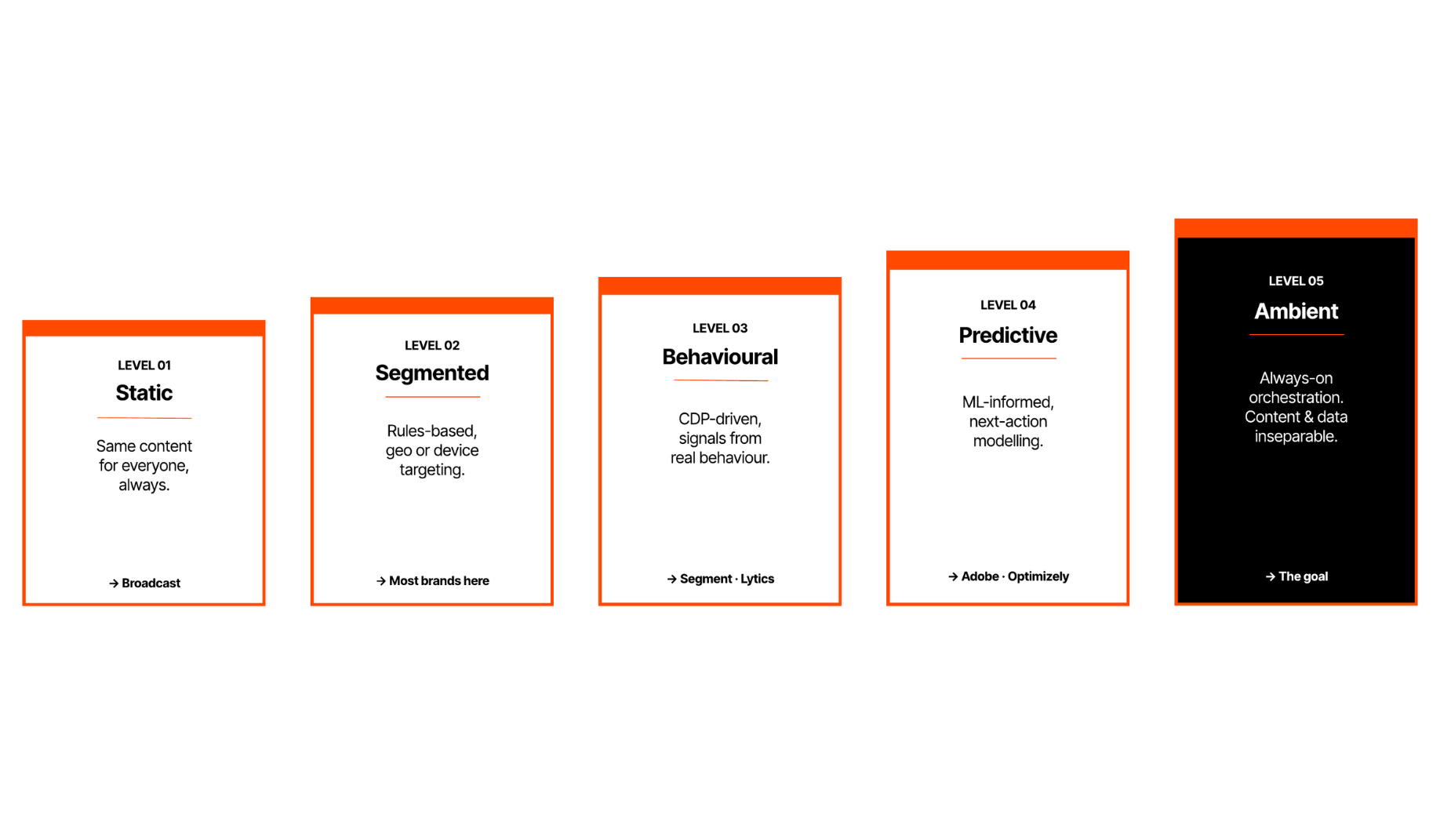
Many teams stall at Level 2 because the CMS makes personalization difficult to implement. If publishing a personalized hero banner requires a JIRA ticket, you won’t be able to personalize anything at scale. The content model has to be designed to support it from day one.
That’s why the content model matters so much. Personalization may look like a front-end feature, but it usually succeeds or fails much earlier in the system.
Why connected teams tend to produce better outcomes
Large digital programs often split responsibility across multiple partners or internal teams. One group owns commerce. Another leads branding and design. Someone else implements the CMS. Data and analytics sit somewhere else again.
That structure can work, but it also creates handoff points. And those handoffs are often where misalignment appears: personalization logic doesn’t make it into content, design intent gets lost in implementation, or governance is left behind altogether.
The challenge usually isn’t a lack of capability. It’s a lack of connection between disciplines.
When content, commerce, data, and experience are planned together, teams are more likely to make decisions that hold up across the full customer journey.
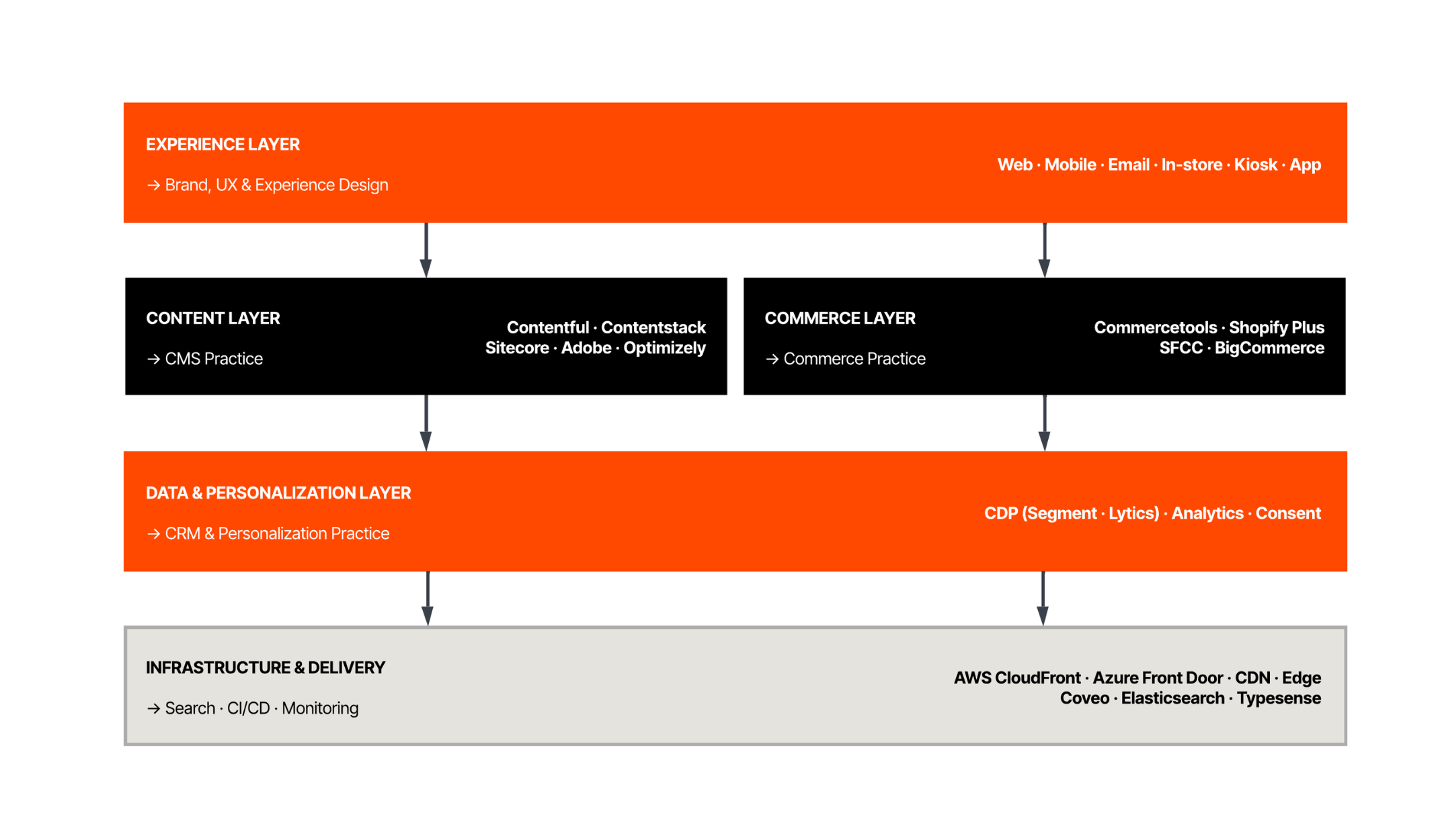
The connected stack: Where content & commerce are peers
They should be connected through data and supported by the infrastructure underneath. The gaps between boxes are where projects most often fail.
A pragmatic path forward
The good news is that most organizations don’t need to replace their commerce platform. They need to fix their content layer: the model, governance, editorial experience, and data connections. That’s a significantly smaller project than a full replatform, and it has an outsized impact on everything downstream.
A useful starting point is a proper content audit. Not one designed to confirm that everything is fine, but one that looks honestly at a few practical questions:
- What content exists today?
- Where does it live?
- What’s working for editors, and what isn’t?
- Which signals exist in analytics, but aren’t influencing content yet?
From there, the work often becomes clearer. A phased approach tends to be more effective: stabilize the content model, improve the editorial experience, connect the data layer, and then build toward more advanced personalization.
Trying to personalize at scale before that foundation is in place usually creates more complexity than value.
The bottom line
It’s easy to overestimate what commerce technology can solve on its own.
A strong platform can make transactions smoother, faster, and more reliable. But it can’t tell a clearer story, build trust, sharpen relevance, or create a stronger sense of momentum for the customer. That work sits in the content layer and in the decisions behind it.
When content is well-structured, well-governed, and connected to data, the overall experience improves. Teams can publish faster. Personalization becomes more practical. Journeys feel more coherent. And the site starts to do more than process transactions. It starts to earn attention.
That’s why content should be treated as core infrastructure, not surface-level polish. In modern commerce, it isn’t secondary to the stack. It’s what makes the stack useful.

Retail consumers still want value, but also proof, deals, & vibes


In February 2026, the DEPT® research team looked across the retail landscape to understand the signals shaping the year ahead.
What we found was an industry in transition. The old link between physical availability and purchase intent has weakened and, in some cases, disappeared altogether.
Retail leaders are no longer just competing for shelf space or share of wallet.
They are competing for ecosystem authority: the ability to shape discovery, trust, relevance, and conversion across a fragmented commerce landscape. As retail moves into the age of agentic commerce and sensory-first discovery, brands need to think beyond simply moving units.
The bigger opportunity is to connect better data, stronger cultural relevance, and more seamless customer experiences.
The hidden economy is becoming retail’s growth engine
For years, retail was largely a margin game. Now, it is becoming a data and media business too.
With Europe’s retail media market projected to hit €31B by 2028 and the U.S. retail media spend forecast to grow by 88.5% between 2024 and 2028, the sector is going through a major reset. The real asset is first-party transactional data: the clearest signal of what consumers value and how they behave.
That creates a new kind of operational pressure for brands. The scale and speed needed to run retail media networks now far exceed what teams can manage manually. Asset variation, channel compliance, audience targeting, and performance optimization have become too complex to handle through traditional workflows.
That is why more organizations are moving toward agentic operations. The goal is not just to keep up with the hidden economy, but to remove friction from it: speeding up decisions, tightening brand governance, and making execution easier to scale.
DEPT®’s work with Sainsbury’s Nectar360 is one example of that shift. Using a multi-agent AI approach, our team cut approval times from weeks to 90 seconds. As retail media grows, that kind of operational efficiency is quickly becoming a competitive advantage.

Physical retail is evolving into a trust and discovery channel
Even as ecommerce continues to grow, physical retail is taking on new importance.
For younger audiences, especially, stores are not just places to buy things. They are places to explore, experience, and validate. Shopping has become more emotional, more curated, and more sensory.
According to PwC, 41% of Gen Z shoppers say they visit stores primarily to see and touch the product (up from 34% in 2024), while 23% say they are making an event out of the trip. At the same time, physical retail remains commercially significant: 50% of Gen Z spending still comes from in-store mass merchandise and grocery purchases.
That matters because discovery today is shaped by aesthetics, algorithms, and imitation. In a market full of dupes, clones, and AI-generated sameness, realness has become a competitive advantage. The store now plays a more important role as the place where brands can prove what is real.
To support that shift, retailers need a stronger link between physical discovery and digital certainty. In practice, that could mean richer in-store product information, connected journeys from shelf to cart, or omnichannel experiences that make availability, fit, and fulfillment easier to understand. Digitizing the store is part of it. But the bigger job is making the whole buying journey feel more seamless, transparent, and trustworthy.
Price-neutral sustainability is the next loyalty play
One of the biggest tensions in retail right now is the gap between what consumers care about and what they can actually afford.
78% of consumers say sustainability matters to them, yet only 20% believe brands accurately represent their sustainability efforts. At the same time, the upside is clear for brands that can prove their case. Products with substantiated sustainability claims have been shown to grow 34% faster than those without, suggesting that shoppers do respond when claims feel specific, credible, and easy to understand.
“40% of Gen Z say they often buy items they will only wear or use once, which says a lot about how quickly affordability can override intention.
”
The tension is especially visible among younger consumers. Gen Z consistently shows stronger intent to buy sustainable products, but intention alone does not guarantee conversion. Younger shoppers often still compromise on cost and convenience: 40% of Gen Z say they often buy items they will only wear or use once, which says a lot about how quickly affordability can override intention.
The challenge is to make sustainability feel easier, not harder. That means moving beyond premium positioning and toward price-neutral sustainability: reducing waste, improving supply chains, and using technology and AI to create efficiencies that can be passed on to the consumer.
Lidl Germany showed what that can look like in practice. Bringing plant-based prices in line with animal-protein alternatives drove a reported 30% uplift in plant-based sales. When the price barrier disappears, behavior changes faster.
That is the real unlock. When sustainability is built into operations, pricing, and product design, rather than added on as a message, adoption follows.
Cultural signals are replacing traditional media hierarchies
Mass awareness is no longer built through a single hero asset. It is built through a collection of signals.
In a multi-screen world, influence moves faster, fragments faster, and spreads differently. Social-first campaigns, creator ecosystems, and community-led behaviors increasingly shape what people notice, talk about, and buy. You can see that clearly around live sports, where more than 90% of Gen Z fans use social media to consume sports content, from clips and highlights to live moments and athlete content.
That demands a different creative model. Instead of asking a single polished campaign to do everything, brands need systems that can spot high-affinity moments, move quickly, and build on signals already gaining traction in culture.
DoorDash’s partnership with 50 Cent on The Big Beef is a good example. Built around the idea that game-day rivalries now play out as much in feeds and comment sections as they do on the field, the campaign skipped the traditional in-game approach and leaned into short-form, shareable content made for the places where audiences were already watching, reacting, and posting in real time.
That is the shift. The distance between scroll and shelf is getting shorter, and brands that can turn cultural participation into commercial intent will have the advantage.
Retail is no longer a vertical
It is an interconnected system of data, trust, media, experience, and operations.
That means brands need to move beyond old distinctions between digital and physical, brand and commerce, media and merchandising. The ones that win will design ecosystems that can respond to changing consumer behavior with more speed, intelligence, and resilience.
That means building agentic efficiency to handle complexity at scale. It means investing in the kinds of connected experiences that strengthen trust and protect brand equity. And it means rethinking value so better choices become more commercially viable for more people.
At DEPT®, we are seeing these shifts play out in real time. From automating ad approvals to helping global retailers build more connected commerce ecosystems, the focus stays the same: turning retail friction into competitive advantage.
Because the future of retail will be defined by who builds the most relevant, trusted, and intelligent ecosystem around the sale.
INEOS Automotive appoints DEPT® as integrated agency of record
British automotive brand selects DEPT® for integrated marketing capabilities across media, creative, digital, and social
Global marketing and technology services company DEPT® has been appointed as the integrated agency of record for INEOS Automotive, the manufacturer of the Grenadier Station Wagon and Quartermaster pickup variant. DEPT® will lead media, creative, digital, and social to accelerate growth through integrated marketing and technology.
The appointment sees the global company working across the full marketing spectrum for INEOS Grenadier.
The scope includes strategic media planning and buying, creative automation, digital channel optimisation, and organic social content, all integrated under one team to drive business growth.
INEOS Automotive selected DEPT® for its ability to blend technology, creativity, and data within a single partner. By bringing technology and marketing capabilities together to connect media, digital experiences, and content under one team, the company is eliminating silos and driving measurable business results. The partnership encompasses both retainer and project-based work.
“INEOS Automotive needed a partner who could drive growth, not just manage marketing. We bring together technology, creativity, and data to solve business challenges in new ways. For INEOS, that means building an integrated system where media, digital, and content all work together, constantly learning and optimising to deliver measurable results. We’re focused on inventing solutions that move the business forward, not just executing campaigns. We can’t wait to get to work with this fantastic product.
”Jack Williams, SVP Growth at DEPT®
“We needed a partner who could bring both strategic thinking and execution excellence over every element of our marketing. DEPT®’s integrated capabilities mean we can move faster and smarter. Their track record in blending creativity, technology, and data made them the clear choice.
”Jonathan Hill, Chief Marketing Officer at INEOS Automotive
DEPT® pilots early ChatGPT advertising integration for Fortune 500 brands
DEPT®, the growth invention company, today announced that some of its clients, including Lumen Technologies, are among the first companies to participate in an early advertising pilot within OpenAI’s ChatGPT.
The initiative reflects the continued evolution of consumer discovery as generative AI platforms reshape how people ask questions, evaluate options, and make purchasing decisions.
As discovery shifts from traditional search engines to conversational AI interfaces, DEPT® is helping brands navigate a new ecosystem where visibility is influenced by both organic inclusion in AI-generated responses and emerging paid advertising formats within large language model (LLM) platforms.
Insights from the ChatGPT test will inform DEPT®’s evolving AI-native marketing frameworks, supporting brands as they adapt to changing patterns of digital engagement.
“We are moving from an era of searching for links to an era of receiving answers. As discovery moves into generative AI environments, brands must manage both organic visibility within AI responses and emerging paid opportunities within LLM platforms. This test allows us to explore how those dynamics work together to drive growth for our clients.
”Dimi Albers, Global CEO of DEPT®
The pilot forms part of DEPT®’s broader Generative Engine Optimization (GEO) strategy, designed to help brands become trusted and recommended answers in AI-driven environments. Building on its 50/50 integration of technology and marketing, DEPT® combines expertise across media, creative, customer experience, data, and organic search to help clients invent, test, and scale new growth drivers in AI-first channels.
The work is supported by DEPT® Orchestrate, the company’s proprietary intelligence platform, which unifies media, creative, and data into a connected, AI-powered workflow to accelerate experimentation and insight generation.
Media continues to be a primary driver of DEPT®’s business. The company now manages more than $5 billion in digital media spend, representing a 25% increase over the past year. This growth reflects expanded partnerships and broader remits with global category leaders, including Logitech, OpenAI, and eBay.
Brookfield Zoo Chicago and DEPT® reimagine the digital experience to bring visitors closer to the animals, mission, and impact.

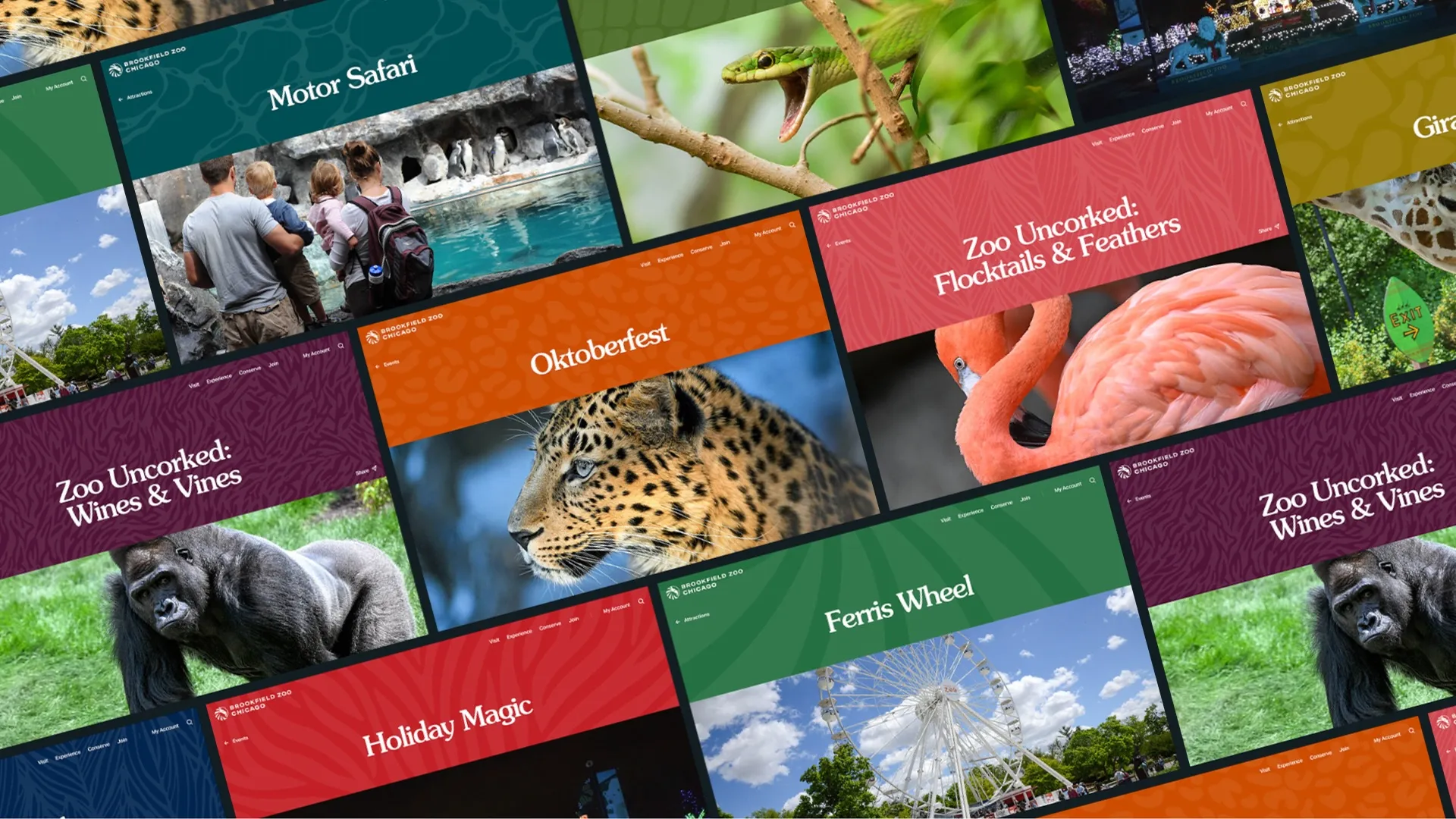
Brookfield Zoo Chicago has partnered with growth invention company, DEPT®, for a bold reimagining of the Zoo’s digital experience, transforming how audiences connect with the iconic institution before, during, and after their visit.
Websites for zoos, museums, and other visitor-driven cultural institutions are often built as operational tools, centered on hours, ticketing, and basic information.
Today’s audiences expect mobile as a given, seek personalized recommendations, and engage long before and after their visit.
The new Brookfield Zoo Chicago platform reimagines the site as a true digital front door, blending immersive storytelling, seamless commerce, and intuitive navigation to inspire exploration, simplify planning, and deepen engagement across the full visitor journey.
““As expectations around mobile performance, accessibility, and personalization continue to rise, we saw an opportunity to rethink how our mission to inspire conservation leadership comes to life online. Together with DEPT®, the new website makes buying tickets easier, planning visits simpler, learning about animals more immersive, and supporting conservation more accessible than ever.”
”Katie Back, Associate Vice President of Marketing at Brookfield Zoo Chicago.
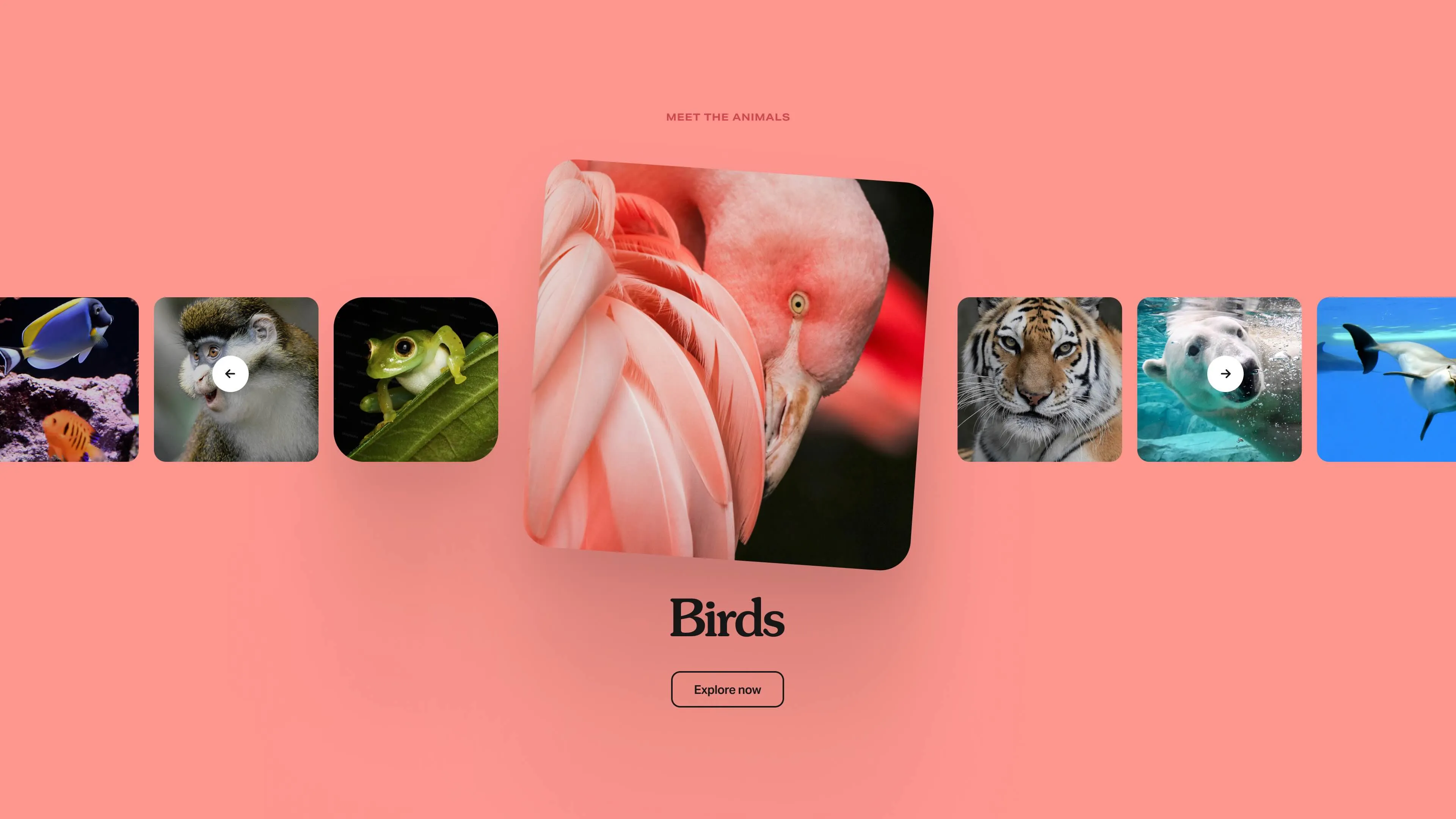
DEPT® led the engagement across digital strategy, experience design, creative direction, and technical development with a clear objective
To build a scalable platform that transforms inspiration into action. Designed around the full visitor journey, the experience seamlessly connects storytelling with commerce, driving ticket purchases, membership, donations, and deeper ongoing engagement.
Through a series of discovery workshops and audience research, the teams identified key opportunities to simplify how visitors navigate the Zoo’s offerings while elevating storytelling around animals, habitats, and conservation work. The result is a scalable platform designed to guide audiences naturally from exploration to participation.
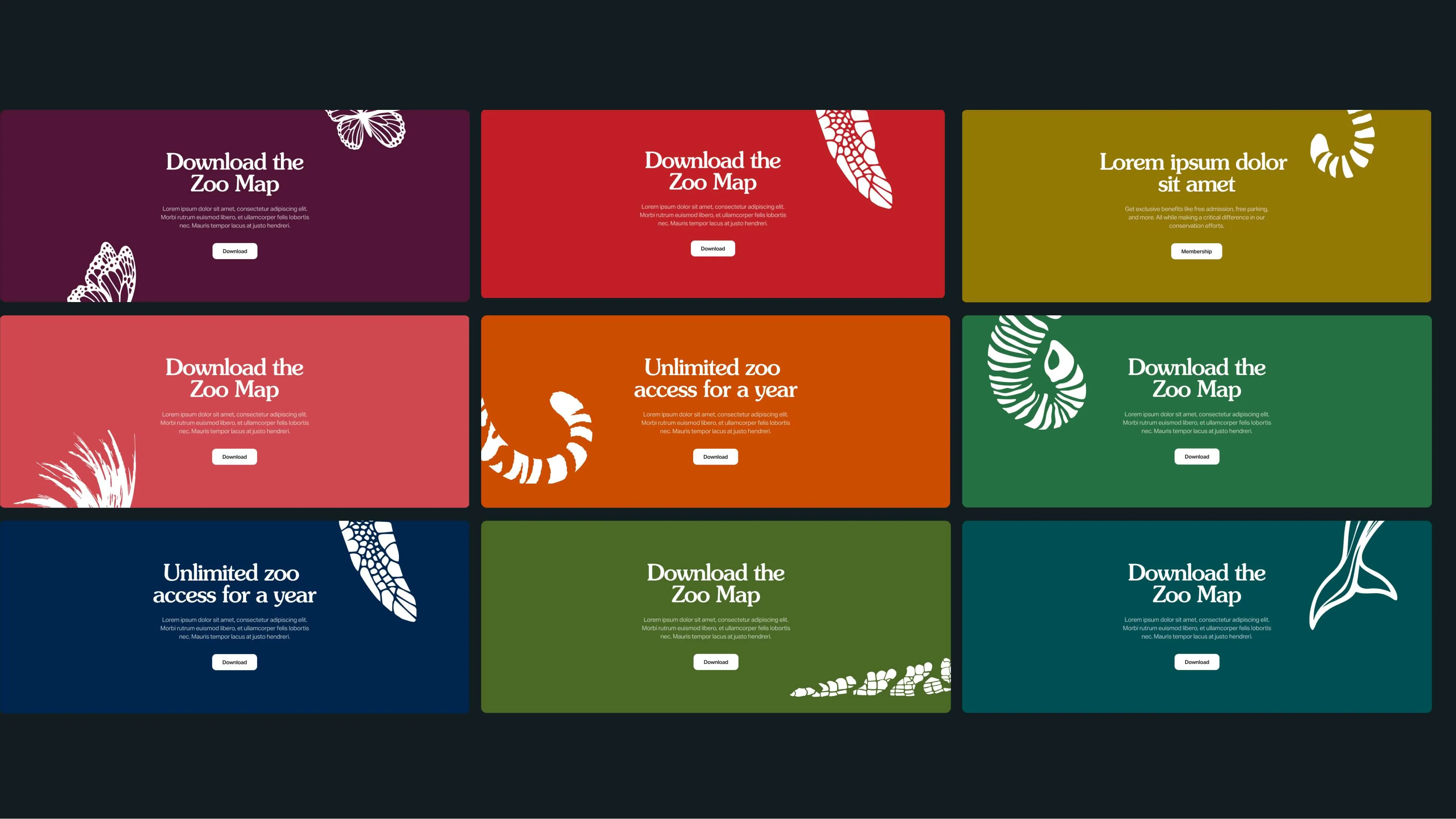
““Our collaboration centered on building a digital experience as dynamic as the Zoo itself. By combining creativity, technology, and data, we’ve helped create a scalable growth engine that deepens audience connection while advancing the Zoo’s conservation mission.”
”Carryn Quibell, Americas CEO at DEPT®
The new site organizes content across four intuitive pillars — Visit, Explore, Conserve, and Support — creating clear pathways from discovery to participation.
Enhancements include:
- A streamlined ticketing and event registration experience designed to reduce friction and increase conversion
- A dynamic daily activities schedule that extends the in-park experience into the digital journey
- Rich animal and habitat storytelling that strengthens emotional connection and amplifies conservation impact
- A mobile-first, accessibility-forward framework built to evolve alongside future campaigns, programming, and partnerships
On the design and technology side, the platform was built to balance immersive storytelling with operational flexibility for internal teams.
Modular content systems, scalable architecture, and accessibility-first design principles ensure the site can continuously evolve as the Zoo expands its programming, partnerships, and conservation initiatives.
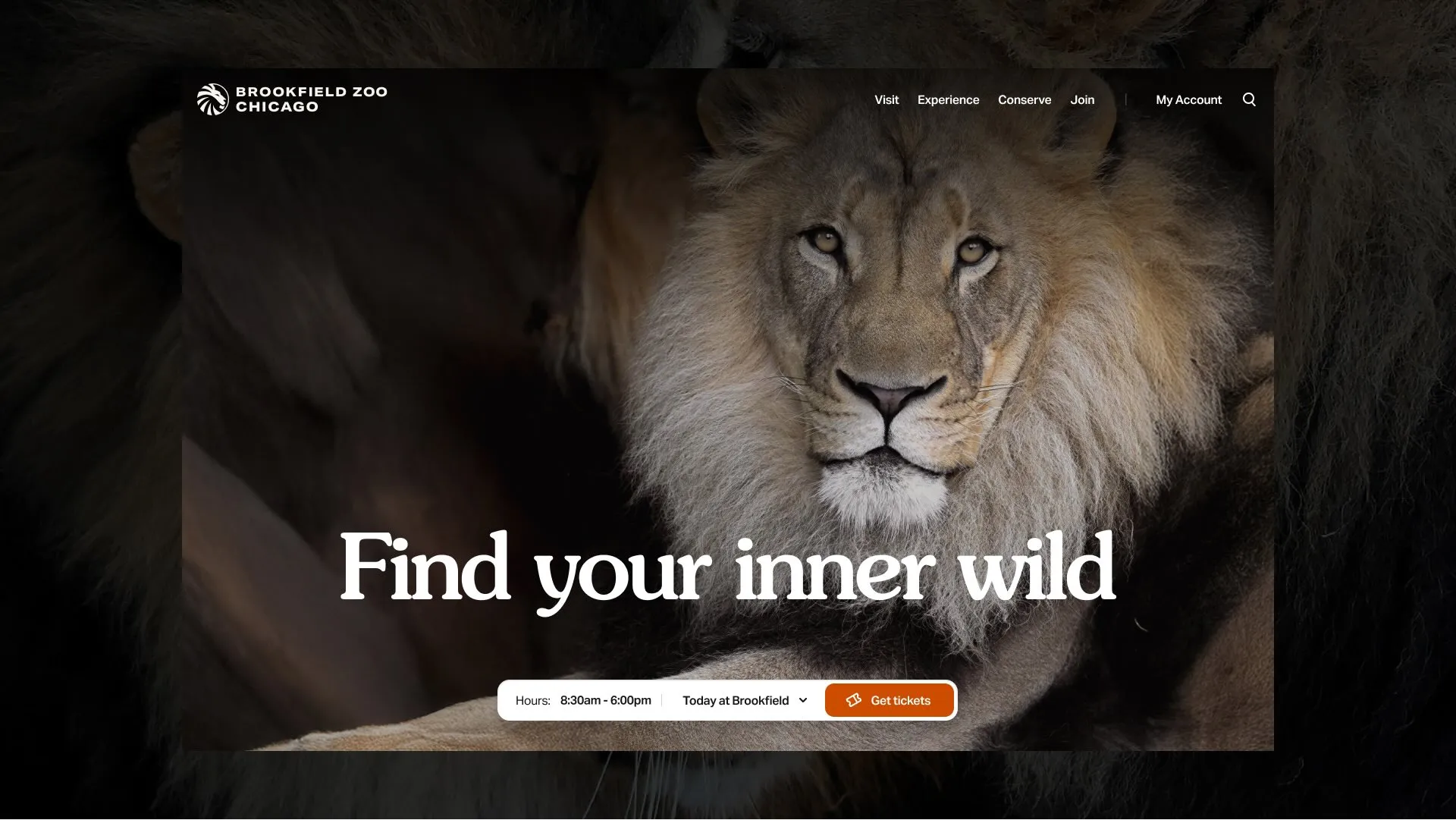
The new website is now live at brookfieldzoo.org.
A different take on the burger bite seen ’round the world


A few seconds. One tiny bite.
And suddenly, a CEO taste test became a cultural moment.
If you missed it: McDonald’s CEO Chris Kempczinski posted a video promoting the new Big Arch Burger. The internet latched onto his stiff delivery, his use of the word “product,” and most memorably, a very small first bite. TikTok did what TikTok does: parody, remix, roast.
The easy takeaway is “don’t let execs do social.” But that’s not the most useful lesson here. Because honestly? The video wasn’t that awful. It had a dad-tryna-do-social awkwardness that can read as….actually pretty endearing.
The bigger story is what the reaction reveals about how people currently feel about McDonald’s and how quickly audiences seize on a single moment as proof of a pre-existing belief.

This wasn’t a content problem. It was a credibility problem.
In a vacuum, the clip is just a corporate leader doing a slightly wooden product promo. But brands don’t live in vacuums. They live inside the narratives people carry around.
For many consumers right now, McDonald’s sits in a mental category that looks something like: corporate, convenience-first, optimized. Not a food company obsessed with making delicious food. When that’s your starting assumption, the CEO calling lunch a “product” doesn’t come across as harmless internal jargon. It’s confirmation.
So when the internet piled on, it wasn’t only judging this single video. It was judging whether McDonald’s still feels like the kind of brand that can credibly talk about food with genuine delight.
Burger King did something smarter than clap back
Burger King’s response landed because it was culturally native and earned.
Instead of an office vibe and ingredient narration, BK’s video leaned into proof with quick visuals, a test-kitchen feel, and the climactic shot everyone was waiting for—an intentional, enthusiastic, big bite of the Whopper. Even the tone stayed playful with BK’s CEO saying, “Only one thing missing — a napkin.”
That matters because in competitive moments, audiences aren’t only measuring wit. They’re measuring credibility. Burger King has a long history of directly challenging McDonald’s, so this didn’t feel like random opportunism. It felt on-brand and sharp, but not mean.
The first credible responder usually gets the cleanest contrast. But once a moment becomes a ‘format,’ latecomers can still earn attention if they bring a distinct POV that’s already believable for their brand. Now that Wendy’s and A&W have entered the chat, the moment has shifted from a two-brand dunk-fest into a broader credibility contest.
You can’t content your way out of a credibility deficit
A lot of post-mortems on moments like this focus on craft: better script, better setting, better edit, better media training.
Sure, those things help. But they’re not the root cause of this viral moment, because when a brand’s credibility is strong, even imperfect content can land as human. But when credibility is weak, even polished content can feel like performance. The internet isn’t only watching what you post. It’s watching whether your brand has earned the benefit of the doubt.
That’s why this moment is more interesting than “cringe CEO video.” It’s a reminder that brand perception is more than background noise. It’s the headline.
What brands can learn (Beyond “don’t be cringe”)
This moment offers a cleaner playbook than most viral marketing lists:
1) Treat virality as a diagnostic, not a dunk. If a moment randomly becomes a roast, ask what pre-existing belief it activated. What story did the audience already have loaded?
2) Rebuild credibility with receipts, not rhetoric. If you want to be perceived as a food brand (not a convenience brand), you need sustained proof: product decisions, quality signals, transparency, and values people can feel.
3) Use humor as a bridge, not a solution. Leaning into the joke can signal listening in the short term. But the long-term work is changing the story that made the joke land in the first place.
The bite seen ’round the world wasn’t really about a bite
It was about belief. And belief is the real battleground for brand trust. Because when trust is strong, even a dad-ish CEO moment can be endearing.
And when trust is weak? Even a burger becomes a product.
Rethinking authenticity in the age of AI influence


Authenticity isn’t disappearing in the age of AI influencers. But it is being clarified.
Because for AI influencers, authenticity is often framed as something that can be simulated but never truly achieved.
And, in a world that prizes authenticity above all else, it’s no wonder that this notion has become one of the most scathing critiques of artificial influence.
But the debate about AI influencers isn’t really about influencers at all. It’s about branding and the assumption that, to be authentic, a brand must be vulnerable in the same way a person is. Capable of failure. Of contradiction. Of genuine emotional risk.
Yet brands have never operated under those conditions. And still, for decades, some have managed to feel unmistakably authentic. If authenticity truly depends on being human, then none of this should work. And yet, for some brands, it clearly does.
So, what separates these brands from the rest of the pack?
(For clarity, when we say “AI influencer” here, we mean virtual personas, AKA, CGI or AI-generated characters, published as recurring social identities.)
Artificial authenticity vs. authentic artificiality
Some AI influencers have been embraced. Some haven’t. And the determining factor all comes down to how these influencers handle authenticity.
On the one hand, we have AI influencers that attempt to meticulously render an illusion of human experience. In the same way that Madame Tussaud’s would attempt to create a 1:1 likeness of a celebrity, these influencers attempt to create a 1:1 performance of authenticity.
The problem with this artificial version of authenticity is that, no matter how convincing the performance may be, the illusion cracks when consumers get a closer look.

Take Shudu Gram. Although she appeared on the social scene as a self-described digital fashion model, her posts looked so real that they were celebrated with hashtags like #blackisbeautiful and shared widely across pages devoted to celebrating women of color.
When it was discovered that Shudu was actually created by a white man (British photographer Cameron-James Wilson) critics began describing Shudu as an ethically fraught projection.
In other words, the problem wasn’t that Shudu was artificial. It was that her artificiality was obscured beneath such a believable veneer of realism.

At the opposite end of the spectrum, there are the AI influencers who embrace their artificiality as part of their trademark. Instead of trying to create a perfect recreation of the human experience, the performance these influencers are attempting is much closer to a parody.
In this camp, we have AI influencers like Noonoouri, a virtual pop star with cartoonishly large eyes and anime-inspired features created by German graphic designer Joerg Zuber.
“I live at the intersection of imagination and innovation, where the best of all worlds becomes one,” Noonoouri writes on her website bio. “Step in, stay curious, and let’s explore the beauty of what’s possible — together.”
Unlike Shudu, Noonoouri isn’t trying to recreate human authenticity. She’s defining it for herself, and her artificiality is a key part of the equation.
The debate around AI influencers, then, isn’t simply about whether or not they’re capable of authenticity. It’s about whether or not humanity is a necessary ingredient for authenticity at all.
Authenticity is what you build
Because we tend to think of influencers as human, we also tend to view authenticity as anchored in lived experience. We associate being “real” with the ability to fail publicly, change our minds, contradict ourselves, or disappoint an audience.
AI influencers, by contrast, exist outside of real-world stakes. Their struggles aren’t felt; they’re written. Their vulnerability isn’t discovered; it’s designed. And for many critics, that makes true authenticity impossible for artificial influencers to achieve.
But that critique depends on a narrow definition of both “influencer” and “authenticity.”
After all, some of the most successful influencers online aren’t human at all. Mickey Mouse has more than three million followers on Instagram. Mr. Peanut racks up millions of TikTok likes. Entire economies of pet influencers thrive online, with no one pretending these creators are consciously curating their brands.
What these examples reveal is something marketers have always known, even if we haven’t named it explicitly: Authenticity isn’t a biological trait. It’s a trust outcome.
And for brands, that trust has never worked the same way human authenticity does. Brands don’t earn it by being vulnerable in the human sense. They earn it by being coherent, intentional, and recognizable over time. By behaving in ways that feel true to who they’ve shown themselves to be.
In this way, authenticity isn’t something you are. It’s something you build, and once you do, it’s something you need to protect.
Character is authenticity’s secret sauce
Character-based influence on social media isn’t new. And it never seems to lose its power.
The jewelry brand Alexis Bittar offers a masterclass with the “Bittarverse,” a serialized social drama following fictional NYC socialite Margaux Goldrich and her long-suffering assistant Jules. Margaux is exaggerated, vain, unapologetically out of touch… and audiences can’t get enough of her.
The Bittarverse characters have a clear POV, defined boundaries, and a worldview that guides every post. The result is something far more authentic than a brand trying to sound “relatable.”
The same pattern shows up among today’s most successful AI influencers.
Granny Spills, for instance, has amassed millions of followers across Instagram and TikTok with her biting social commentary and glamorous disdain. She isn’t trying to pass as human. She’s leaning fully into character.
And that’s precisely why she works.
Granny Spills’ success illustrates a crucial lesson: Strong personality and clear POV are just as much creative choices as they are strategic ones. A well-defined character makes content more entertaining, more scalable, and easier to govern. It creates clarity about what the brand will say, how it will say it, and where the line is.
By contrast, AI influencers that aim for subtlety often end up in dangerous territory. When artificial personas try too hard to mimic human authenticity, they risk feeling hollow or uncanny. Worse, they become difficult to manage—because without a strong character, there are no guardrails. And without guardrails, consistency collapses.
And even beyond consistency, character helps establish accountability cues. A clear persona makes it easier for an audience to understand what’s “in bounds,” what’s performative, and what the brand actually stands for beneath the bit.
Looking ahead
The question isn’t whether AI can ever be authentic in a human sense. It’s whether brands are disciplined enough to build characters strong enough to be authentic in a brand sense. Characters with lore, point of view, and limits. Characters designed not to imitate humanity, but to express something true.
Before you invest in a virtual persona, pressure test your strategy with three questions:
- Are we building a character, or trying to pass as a person? If the goal is realism, you’re also signing up for higher expectations around disclosure, representation, and audience trust. If the goal is character, you can establish clearer boundaries—and avoid the uncanny valley of “almost human.”
- What’s the POV, and what are the limits? What does this persona reliably believe, critique, or celebrate? What do they not touch? If you can’t define the boundaries, the persona will eventually drift, contradict itself, or become a liability.
- Who owns accountability? When something lands poorly (and eventually, something will), who is responsible for the response? Who signs off? What’s the escalation path? “It’s AI” is not a crisis plan.
Brands need not build AI influencers that chase realism. But they need to understand how to treat authenticity as what it has always been.