

Optimization in the age of AI: Understanding GEO


Anyone who has used Google in the last two-ish years has seen that the search engine, and the wider search environment, is changing.
Rather than links to outside pages, AI-generated summaries of these pages’ content now dominate the search engine results page (SERP). For users, it means quick answers that don’t require a second click. For brands, this changes the entire game of discoverability.
When answers are generated instead of found through clicks, visibility stops being about where you rank on the SERP and starts depending on whether you show up at all. Systems like ChatGPT, Perplexity AI, and Google AI Overviews don’t present ten blue links for users to peruse. Instead, they assemble a response from a narrow set of sources they deem relevant and trustworthy. They may also link to or cite high quality, original content as a top source. If your brand isn’t part of that set, it’s effectively invisible at that moment.
Most marketers understand this shift, but many underestimate what it actually means and what it will take to address it. Strong SEO performance doesn’t guarantee inclusion, and incremental content updates don’t move the needle if your brand isn’t being picked up, cited, or reinforced across the ecosystem these systems rely on.
Generative engine optimization (GEO) is how you close that gap. It’s not a replacement for SEO, but an extension of it that focuses on strengthening the entity of your brand from a 360- degree perspective—making your brand eligible to appear inside AI-generated answers, not just alongside them.
What is generative engine optimization (GEO)?
Generative engine optimization is the practice of optimizing content and overall digital presence so that a brand is surfaced, cited, and recommended by AI systems such as large language models, AI search engines, and conversational assistants.
Unlike traditional SEO, which focuses on ranking web pages in search results, GEO aims to influence how AI systems interpret, select, and present information when generating answers. That includes what exists on your website as well as how your brand appears across the broader digital ecosystem that those systems rely on.
In practice, GEO sits at the intersection of content structure, authority, and distribution. It requires creating content that’s clear enough for machines to extract, credible enough to be trusted, and present enough across the web to be retrieved in the first place.
For brands, GEO is not just an SEO problem. It is a content, PR, technical SEO, product data, and brand authority problem.
GEO vs SEO vs AEO vs LLMO: what’s the difference?
There’s no shortage of new acronyms here, and most of them overlap. The useful way to think about these approaches is as different lenses on the same shift, from ranking pages to shaping answers.
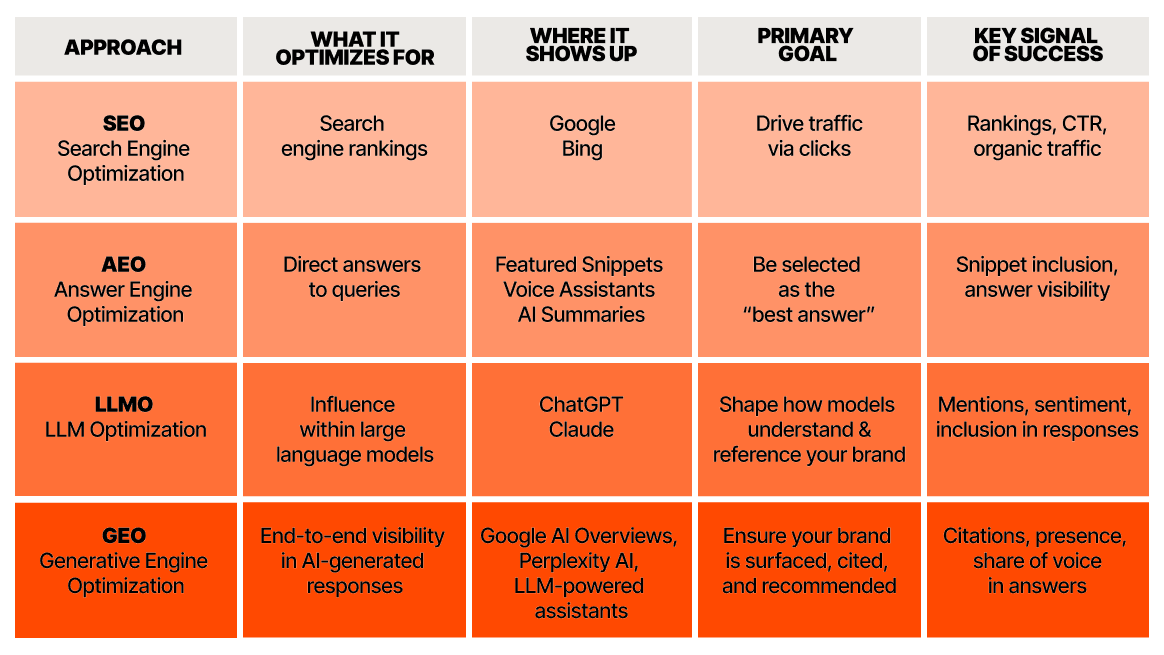
SEO is still the foundation. If your content isn’t crawlable, indexable, and relevant, it won’t be considered anywhere else.
AEO narrows the focus to answering specific questions clearly enough to be selected as a direct response. LLMO goes a level deeper, focusing on how models interpret and represent your brand based on training data, retrieval sources, and broader context.
GEO pulls these threads together. It’s the most complete view of how brands show up in AI-driven discovery, combining structured content, technical foundations, and off-site authority to influence not just whether you rank, but whether you’re included in the answer at all.
How generative search and AI engines actually work
Traditional search retrieves documents and ranks them. Generative systems retrieve a much smaller set of sources and then generate a response using those sources as inputs. This means you’re competing to be one of the few inputs the model uses to construct the answer.
If you treat generative search like a black box, GEO turns into guesswork. The mechanics may not be simple, but they’re predictable enough to design for.
At a high level, systems like ChatGPT, Perplexity AI, and Google AI Overviews combine two things:
- Pre-trained knowledge: what the model already “knows”
- Retrieved information: what it pulls in real time to answer a query
Large language models are trained on vast datasets, but that alone isn’t enough for current, accurate answers. That’s why most modern systems use some form of retrieval augmentation to pull in fresh content from the web or trusted sources at query time.
So, your brand can influence responses through long-term presence (training data, historical content) or through current visibility (what’s being indexed, cited, and retrieved now). If you’re missing from both, you’re not part of the answer.
Keep in mind that even if a system doesn’t show citations, it likely still relies on them internally. And when a model retrieves content, it’s looking for signals like:
- Clarity (can this be easily extracted?)
- Consistency (does this align with other sources?)
- Authority (is this source credible?)
In environments like Perplexity AI and Google AI Overviews, those sources are often surfaced directly. In others, they shape the answer behind the scenes.
Either way, the implication is the same: Being a source matters more than being a highly ranked search result. Top-ranking pages might not be retrieved and cited in an AI answer, while a lesser-known source gets selected because it’s clearer or more directly answers the question.
Why GEO matters for brand discovery
As AI systems’ capabilities expand, consumers are leveraging them to compare options, narrow choices, and even complete actions on the user’s behalf. What starts as a prompt (such as “Why do I keep waking up hot at night?”) increasingly ends as a recommendation (“This brand offers sheets designed to keep you cool”), or even a transaction (“Would you like me to add the queen size to your cart and check out?”) without the user ever visiting a brand’s site.
Platforms like ChatGPT, Perplexity AI, and experiences powered by Google AI Overviews are already collapsing steps in the journey:
- Discovery happens inside the interface
- Consideration is shaped by a synthesized set of options
- Decisions are influenced by how brands are framed, not just found
This is where agentic behavior starts to matter. AI systems act as commerce intermediaries, filtering the market down to a handful of recommendations based on relevance, confidence, and context. In some cases, agents can even complete transactions on a users’ behalf, and this method of e-commerce is only expected to become more popular.
The result is a different model of brand discovery, in which visibility is determined upstream, within AI systems. GEO matters because it positions your brand inside this compressed customer journey. When your brand is properly optimized, it can be selected, interpreted, and recommended when AI systems and agents effectively act as the front door to your category.
Brand spotlight: Auditing the presence of a global beauty company
When we looked at how a global beauty company was showing up in AI-generated responses, we discovered a gap in where its content lived and how it was being reinforced.
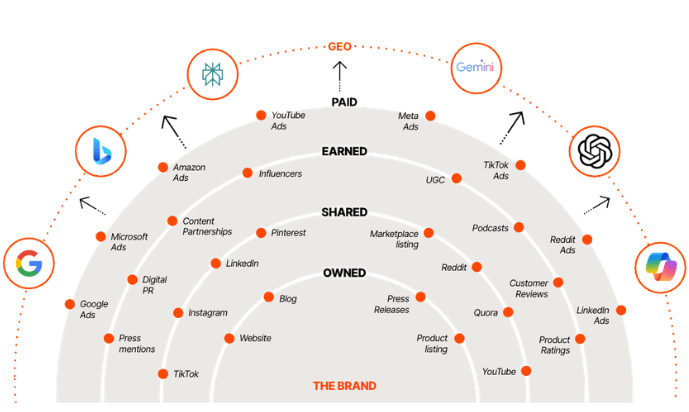
Our audit found that user-generated platforms were dominating citations, with forums and video content consistently appearing in AI answers ahead of brand-owned content. In fact, UGC sources accounted for a significant share of cited inputs, while platforms like YouTube and Reddit were referenced across multiple stages of the journey.
The implication was that discovery wasn’t being driven by the brand’s own content. It was being shaped by the sources AI systems were actually pulling from—forums, videos, and creator-led content. The strategy shifted from publishing more on-site to activating Reddit communities, partnering with creators on YouTube, and producing content aligned to the formats AI systems consistently cite.
How generative engine optimization works in practice
Rather than approach GEO as a set of new tactics to implement, a better way to think about it is ensuring your brand meets the conditions AI systems rely on when they decide what to include in an answer. That is achieved through doing a few things well and in tandem.
Content that can be used in answers
AI systems favor content that’s easy to interpret and reuse, which typically requires clear structure, direct language, and sections that can stand on their own. Definitions, summaries, and tightly written explanations are far more likely to be pulled into responses than long, narrative-heavy blocks.
A clear, consistent understanding of your brand
These systems are constantly trying to resolve what your brand is, what it does, and how it relates to a category. If that picture is inconsistent—differing descriptions on various platforms, unclear or conflicting positioning, weak associations with your category—it becomes harder for a model to confidently include you. Consistency across your site and other sources helps reinforce that understanding.
Presence and credibility beyond owned channels
AI systems lean on a broad set of sources beyond your website to validate what they surface. Brands that are referenced in credible third-party environments, including publications, partner sites, or industry content, are more likely to be treated as reliable inputs.
That also extends to where conversations are happening. Discussions on platforms like YouTube, Reddit, and LinkedIn help reinforce how your brand is understood in context—what it’s associated with, how it’s described, and whether it’s part of the broader dialogue around a topic.
A foundation that still supports discovery
None of this works if your content isn’t accessible in the first place. Crawlability, indexation, and clean site structure still play a role in whether your content gets retrieved at all. GEO builds on those fundamentals rather than replacing them.
Brand spotlight: Streamlining authority for a leading fintech brand
For a large financial services brand that already dominated traditional search, the new challenge was ensuring it could also be consistently understood and cited in AI-generated responses.
The issue wasn’t a lack of content, but fragmentation across the brand’s owned platforms. Core knowledge was spread across multiple domains and formats, making it harder for AI systems to retrieve consistent, authoritative answers. We restructured the approach around a more unified knowledge layer, clearer entity definitions, and stronger governance over how information is created and updated.
Even early changes made a measurable impact. The brand saw tens of thousands of AI citations, a majority brand mention rate, and strong positive sentiment in non-branded prompts, indicating that improving structure and consistency directly influenced how the brand was surfaced and represented in AI-driven environments.
Generative engine optimization FAQs
What is generative engine optimization (GEO)?
Generative engine optimization is the practice of optimizing content and digital presence so that a brand is surfaced, cited, and recommended by AI systems such as large language models and AI-powered search experiences. It focuses on influencing how answers are constructed, not just how pages rank.
Is GEO replacing SEO?
No. SEO is still foundational—if your content isn’t crawlable, indexable, and relevant, it won’t be considered in any environment. GEO builds on that foundation by optimizing for how information is selected and used in AI-generated responses.
Is search disappearing?
No, search is evolving rather than disappearing. Users are increasingly asking questions in natural language and receiving synthesized answers instead of navigating through lists of results. The need to find information remains the same, but the interface and mechanics of discovery are changing. GEO helps brands remain visible as those experiences become more AI-driven.
Is AI Mode the new default Google Search experience?
Not yet. Traditional Google Search remains the primary experience for most users, but Google is increasingly integrating AI-powered features such as AI Overviews and AI Mode into the search journey. As adoption grows, brands will need to optimize not only for rankings, but also for inclusion in AI-generated answers and recommendations.
What is the difference between GEO and AEO?
Answer engine optimization (AEO) focuses on structuring content to directly answer specific questions, often for featured snippets or voice assistants. GEO takes a broader view, incorporating content, authority, and distribution to influence how AI systems generate and present responses.
How do you optimize for AI search engines like ChatGPT or Google AI Overviews?
Optimizing for AI search involves creating structured, clearly written content, reinforcing consistent brand positioning, and building a credible presence across the sources these systems retrieve. It’s less about individual tactics and more about making your brand easy to find, understand, and trust.
How do you measure GEO performance?
There isn’t a single ranking metric. Look at signals like how often they are cited or mentioned in AI responses, how they are positioned relative to competitors, and whether they are included in recommendations across platforms.
Brand discoverability becomes system-driven
As the mechanics of search change, the critical shift lies in where decisions are made. AI systems are taking on a larger role in discovery, evaluation, and recommendation, and the surface area where brands can influence outcomes is shrinking and becoming more concentrated. What used to be a competition for attention across a page of results is now a fight for inclusion in a response.
The goal becomes being understood, trusted, and selected when a system is deciding what to show. Generative engine optimization is how brands adapt to that reality. To see how this plays out in practice, explore our case studies on AI-driven discovery and our framework for building visibility in generative search environments.
And for teams already investing in content, search, and brand, it’s less about starting over and more about making those efforts work in a different environment.