

Beverage Icon
Bringing AI-powered mentorship to an innovation incubator

( Services )
- AI Transformation
- Customer Experience
Most great ideas never become anything.
Not because they aren’t good enough, but because the person behind them lacks the confidence, support, or structure to bring them to life.
Traditional pathways for backing ideas often make this worse. Blank forms, rigid criteria, and intense competition can intimidate applicants before they even begin.
To bring more good ideas to life, we helped a major global brand create an AI-powered innovation incubator designed to inspire rather than intimidate and to help every applicant transform their lightbulb moment into a fully fledged concept.
-
160,000
Total incubator submissions
-
Zero
Reports of content safety violations
-
2,000
Universities
A little support goes a long way
Mental roadblocks are the primary reason why young adults don’t pursue promising business ideas. Nearly half of students say they don’t dare start a business because they’re afraid of failing. Women are disproportionately affected, with 25% fewer saying they have the skills to become entrepreneurs compared to their male peers.
The good news is that mentorship and the support of others change this. Nearly a third of founders say mentorship was a key contributor to their journey, and 73% say that access to an incubator or accelerator was key to their success.
Give someone the right scaffolding at the right moment, and the idea that was sitting quietly in the back of their mind becomes something real.
As a brand with a long history of backing unconventional talent and bold ideas, our client wanted to formalize that spirit into something that could create genuine impact, and the concept for their incubator was born.
Our role emerged when they saw the opportunity to transform the application process by leveraging AI to create a tool that would help students further develop their ideas or even inspire new ones.
We helped our client envision something beyond the scope of typical AI tools or chatbots. Something that would use AI to provide the type of personalized support that comes with mentorship, meeting students exactly where their self-doubt lives.

Transforming mentorship into a full-fledged experience
The incubator needed to be capable of operating across 50+ countries, 9 languages, and more than 2,000 universities worldwide.
At the same time, the incubator’s experience needed to be worthy of its ambition: Use AI not to replace the student’s thinking, but to unlock it.
We structured the experience around two distinct but connected flows. One for students who didn’t yet have an idea, and one for students who did but needed help shaping it.
The brainstorm flow
The Brainstorm Flow was designed for students who felt drawn to entrepreneurship but had no concrete idea, niche, or starting point.
Rather than presenting them with an open text box (which would invite those pesky mental roadblocks), we built a guided discovery experience. Students begin by selecting from a set of areas of the world they care about, problems they’re drawn to, and domains where they feel some intuition or passion.
From those selections, the LLM we built dynamically generates a set of relevant business problems and potential solution directions. The LLM also generated a one-liner concept summary, representing the end of the user flow, that the student carries forward into the next stage.
The key design principle here was restraint. The AI surfaces possibilities; the student makes choices. Nothing is decided for them. The idea that emerges is still theirs; the tool has simply helped them find it.
The submission flow
The Submission Flow takes over once a student has an idea, whether they arrived with one or developed it through the Brainstorm Flow, and puts it through its paces.
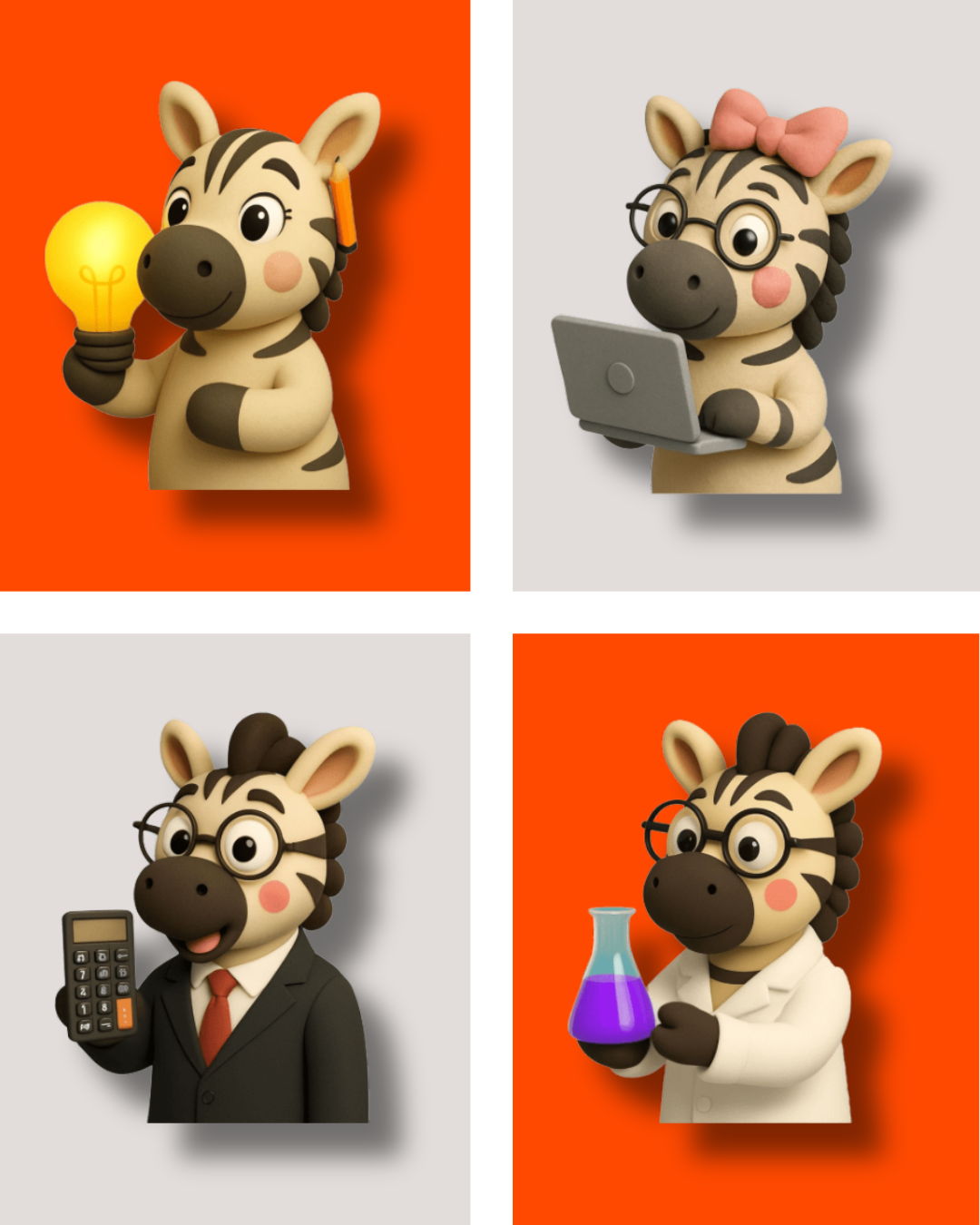
Instead of creating a single AI-powered chatbot designed to ease the strain of the application process, we created four distinct AI personas. Each is built to act as a personalized mentor, providing expert advice and approaching the student’s idea from a unique POV.
The critical thinker challenges assumptions and pushes the student to think long-term. What does the world look like if this idea succeeds? What are you assuming that might not be true?
The technology expert probes technical feasibility and implementation. How does this actually work? What would need to be built, and is that realistic?
The business expert examines market opportunity and commercial viability. Who is this for? Why would they pay for it?
The fact-checker grounds the idea in evidence and rigorous thinking. Is there research that supports your logic? What would you need to prove?
The rationale for four agents rather than one goes beyond product design. What we wanted to replicate was the experience of discussing an idea with a real group of experts. That type of back-and-forth exchange, when it’s supportive rather than hostile, is precisely what sharpens a pitch from vague to compelling.
The agents also interact with each other’s outputs, building progressively across the session. By the time a student has worked through all four perspectives, the platform has helped them construct a fully structured, one-page pitch canvas that they can download, share on social media, or submit directly to the competition.
AI safety as the standard
With an audience this large, we had to ensure we designed the incubator’s AI-powered experience for virtually any potential user… Including the ones who will try to break it.
Initially, we planned to use Microsoft Azure’s built-in content safety tooling. During testing, however, we found it too blunt for this context: some inappropriate content passed through, while some legitimate inputs were incorrectly blocked.
To solve this, our team created a multilayer content-filtering system that performs sequential checks on every user input:
- Layer 1: The Block List. A simple, non-AI list of client-defined “no-go” words, including key competitors for the brand, designed to prevent the LLM from engaging in certain topics that would harm our client’s brand.
- Layer 2: Azure Content Safety. We incorporated Azure into the system as an additional precaution, adjusting its sensitivity to a level that was neither impenetrable nor ineffective.
- Layer 3: Custom LLM Classifier. This is the core “magic” of the system: two tiers of LLM-based evaluation that we created by drawing on several open, highly regarded AI content safety datasets in our industry. The first tier is built to check for brand safety and topical relevance at a broad level, while the second is designed to provide an additional layer of security by checking for subtler violations of intent.
Nothing reaches the mentor agents until it has passed every layer of the system, and the result was robust enough to handle a global, consumer-facing product with our utmost confidence.
An experience with lasting impact
The incubator experience went live and grew quickly. Daily submission volumes climbed consistently week-over-week, peaking at over 1,600 submissions in a single day. Out of a total of over 160,000 submissions, we’ve received zero reports of content safety violations.
In fact, the success of this project’s AI guardrails led us to incorporate the multilayer content filtering system we created as a new safety standard for all future work with B2C AI-enabled experiences.
Above all, we remain proudest of the impact on both the incubator’s users and our client.
By integrating AI into the experience, we helped ensure that no one left the incubator empty-handed. Whether or not their idea is selected for funding, each student who uses the platform can further develop their idea and take home resources to bring it a step closer to reality.
For our client, the renewed experience represents a bold, creative use of AI that demonstrates their belief that all people need only a little push to accomplish even the most brazen, seemingly impossible feats. And, in this case, that push comes from giving everyone a shot at mentorship.