

Why great commerce experiences start with better content


You’re probably sitting on powerful commerce infrastructure.
Your cart works. Checkout is fast. Promotions are automated. Inventory is accurate.
And yet the experience feels thin.
That’s usually because commerce has been treated as the main event, while content has been left to support from the sidelines. But customers don’t arrive ready to transact. They arrive with questions, hesitation, curiosity, and competing options. What helps them move forward is not just the platform underneath the site. It’s the experience wrapped around it. And that experience is shaped by content.
Commerce platforms are very good at helping people buy. They are not designed to do all the work of helping people understand, trust, compare, imagine, and decide. That gap is where many brands struggle. The stack may be technically sound, but if the content layer is weak, disconnected, or hard to manage, the overall experience starts to feel functional rather than compelling.
That’s the real issue: a commerce stack can process demand, but it can’t create it on its own.
Content connects discovery & conversion
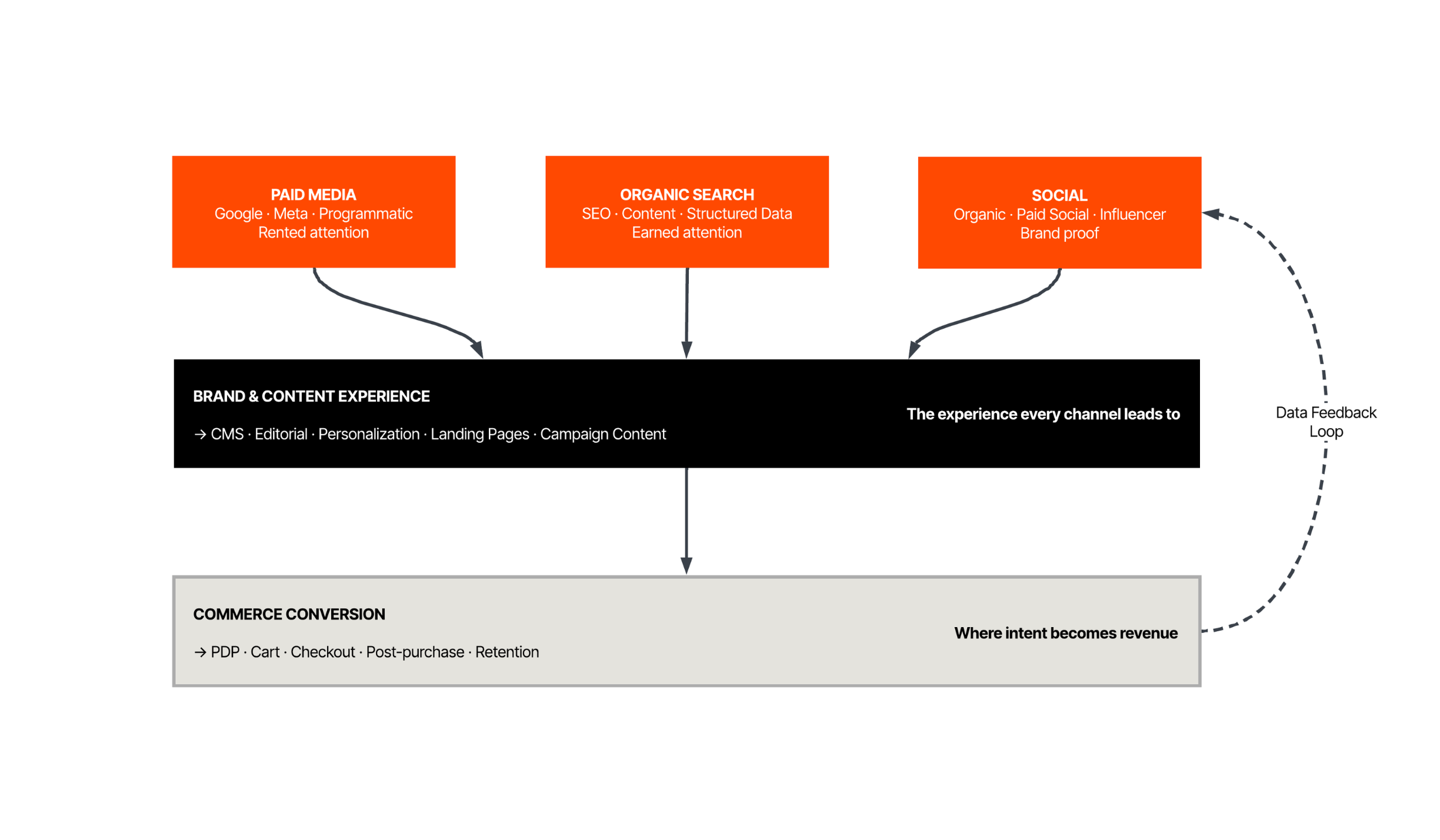
Content does more than support the on-site experience. It also shapes what happens before someone ever arrives.
Paid media, search, and social may drive discovery, but they only work as well as the experience they lead to. A weak landing page, thin editorial support, or disconnected campaign message makes acquisition less efficient from the start. Strong content improves on-site engagement and helps every channel work harder.
That matters because customers do not move through digital experiences in neat organizational paths. They might discover your brand through paid media, compare options through search, build trust through editorial content, and convert through the commerce experience. To them, it is one journey. If the content across those moments feels inconsistent, generic, or hard to manage, the gaps start to show.
That is why content, commerce, and channel strategy should not be treated as separate systems. Content is the connective layer between discovery, consideration, and conversion.
The CMS may not be the problem, but the implementation often is
Many teams come away from CMS projects frustrated. They choose a respected platform like Contentful, Contentstack, or Adobe, but the result still disappoints. Editors struggle to use it. Developers become the bottleneck for simple changes. Publishing takes too long. Campaign content gets hardcoded. Everyone feels the friction.
But the uncomfortable truth is the platform is almost never the problem. The problem is the implementation. Specifically, a content model designed by developers, for developers, that treats editors as if they’re filing tickets rather than crafting experiences.
A strong CMS architecture usually starts with questions that have very little to do with technology:
- How does the editorial team think about content?
- What does that content need to do across channels?
- How should data influence what gets shown, and when?
Those answers should shape the implementation, not the other way around.
A practical CMS framework
Sequenced discovery before a single line of implementation code is written.
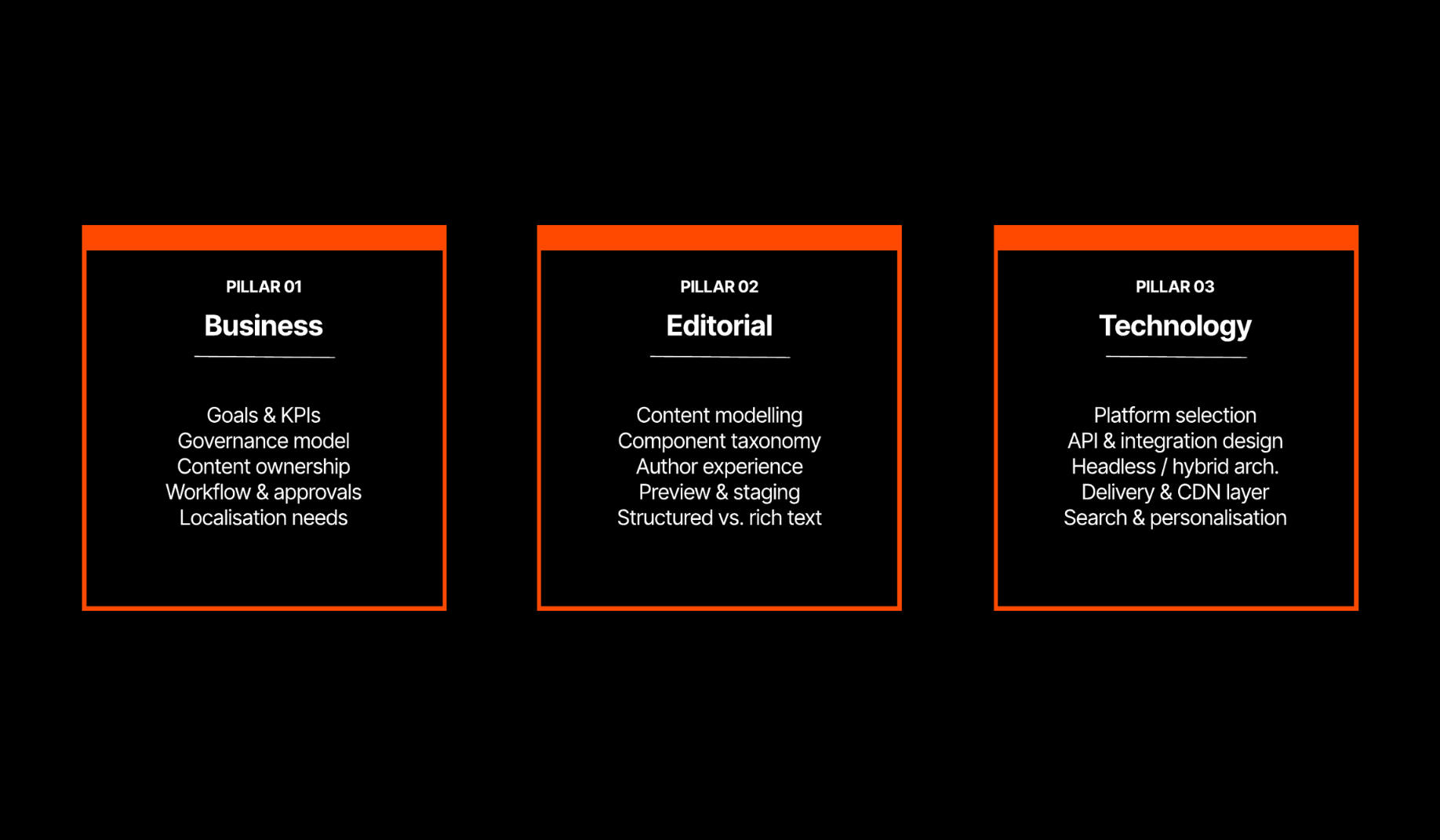
The most common mistake in CMS implementations is letting the platform’s “getting started” guide become the content model.
It may help a team get moving quickly, but it rarely reflects how brand teams work, how governance functions, or how content needs to scale over time.
That’s why content modeling is one of the most important design decisions in the stack. It shapes not only what gets published, but also how easily teams can adapt later.
The personalization gap: Data, signals, and relevance at scale
Almost every brand says it wants personalization. Many already have a CDP, or at least access to one. Some have run homepage tests or built audience segments. But far fewer have connected those signals to the content that actually gets rendered on the site.
That gap is common.
The challenge is usually operationalizing data in a way that editors and marketers can actually use. That requires a few things that often get overlooked in platform-led projects:
- A clear customer strategy that defines which signals matter and why
- Consent management that works in practice, not just technically
- A content model flexible enough to support variant delivery
Personalization maturity model
Many organizations believe they have reached Level 4, but in practice are still operating closer to Level 2.
Level 1 — Static
The same content is shown to everyone.
Level 2 — Segmented
Rules-based targeting by geography, device, or basic audience logic.
Level 3 — Behavioral
Content responds to real behavioral signals, often through CDP input.
Level 4 — Predictive
Machine learning helps inform the next best action or experience.
Level 5 — Ambient
Content and data work together continuously across the journey.
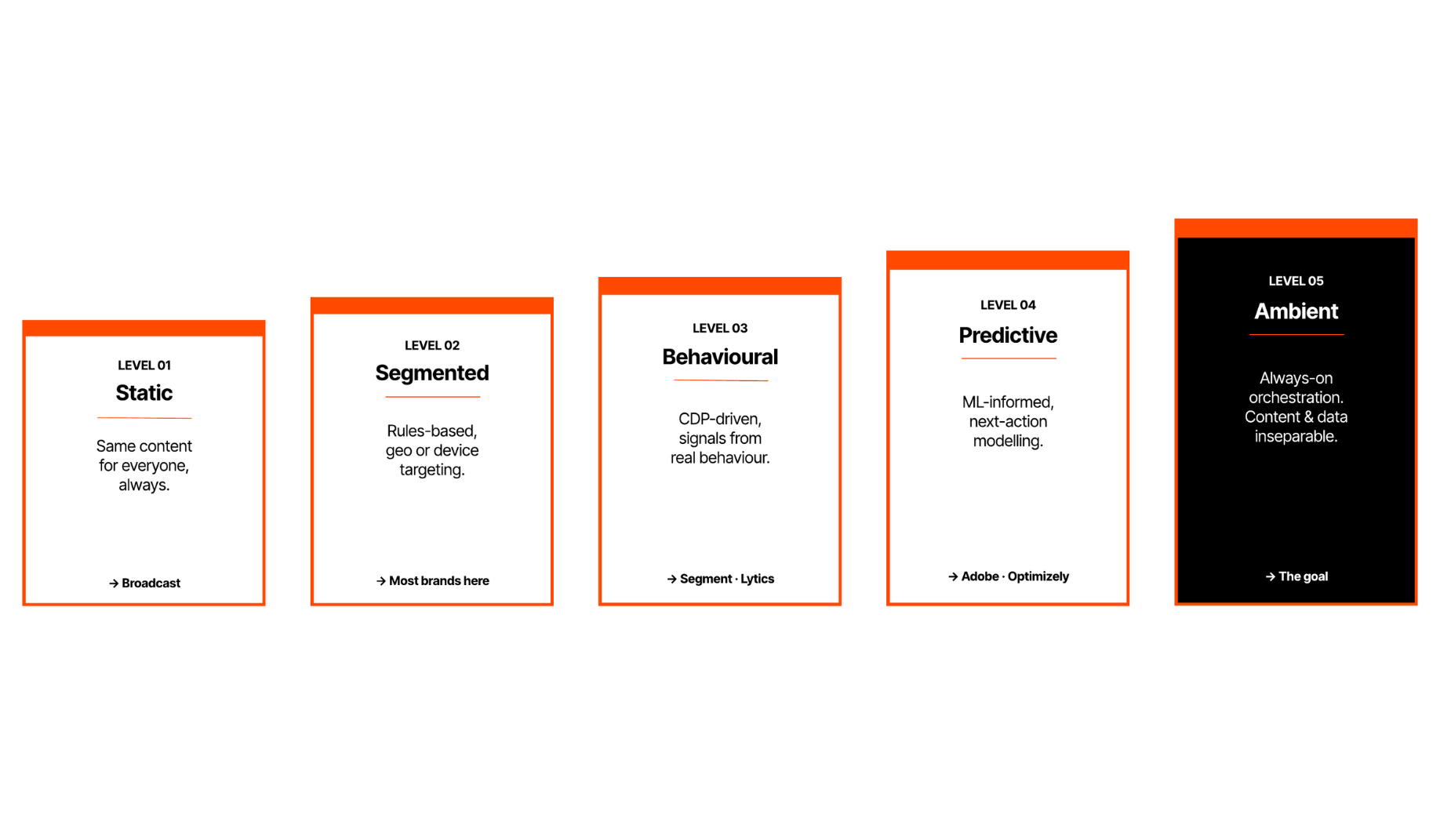
Many teams stall at Level 2 because the CMS makes personalization difficult to implement. If publishing a personalized hero banner requires a JIRA ticket, you won’t be able to personalize anything at scale. The content model has to be designed to support it from day one.
That’s why the content model matters so much. Personalization may look like a front-end feature, but it usually succeeds or fails much earlier in the system.
Why connected teams tend to produce better outcomes
Large digital programs often split responsibility across multiple partners or internal teams. One group owns commerce. Another leads branding and design. Someone else implements the CMS. Data and analytics sit somewhere else again.
That structure can work, but it also creates handoff points. And those handoffs are often where misalignment appears: personalization logic doesn’t make it into content, design intent gets lost in implementation, or governance is left behind altogether.
The challenge usually isn’t a lack of capability. It’s a lack of connection between disciplines.
When content, commerce, data, and experience are planned together, teams are more likely to make decisions that hold up across the full customer journey.
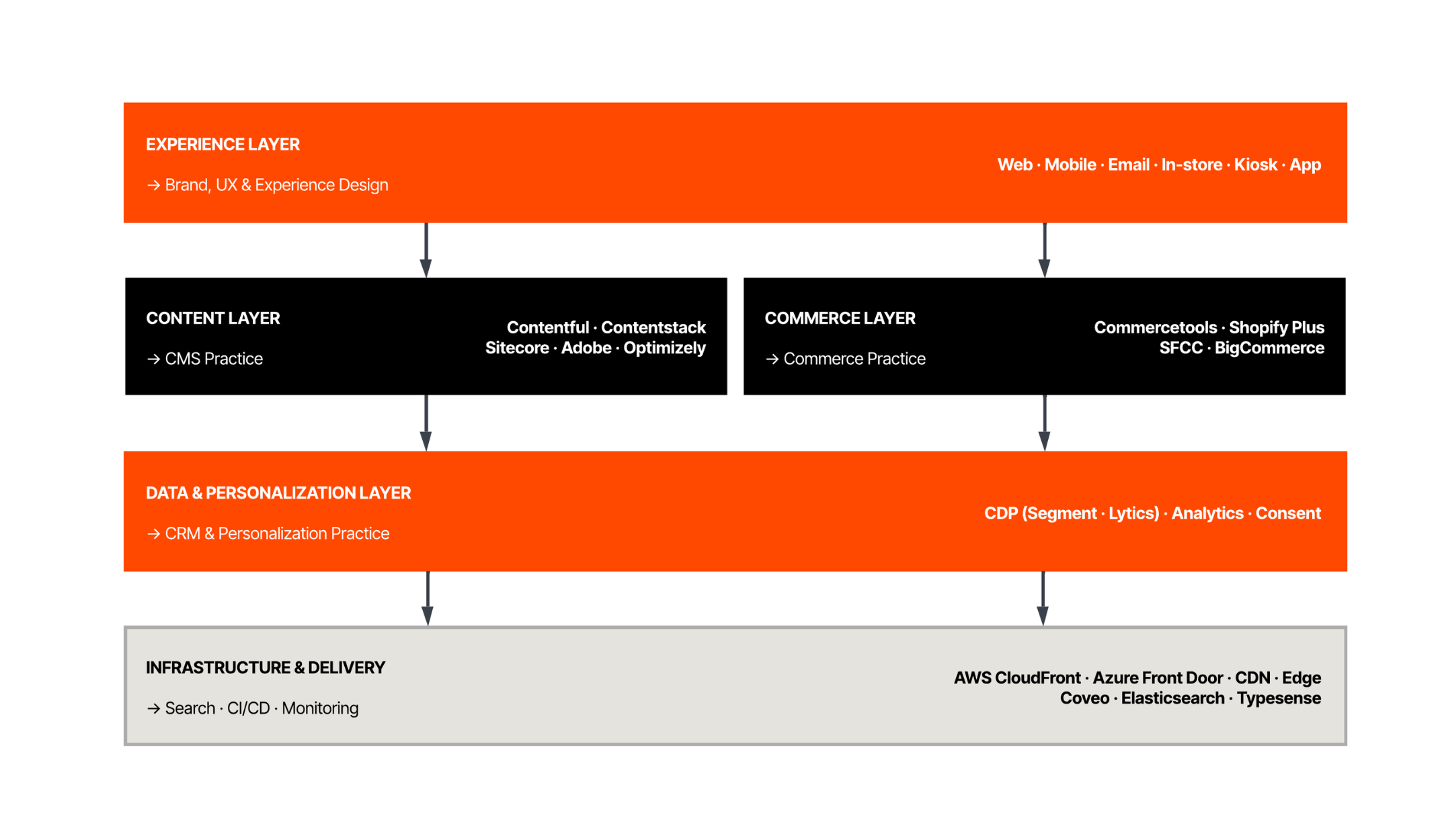
The connected stack: Where content & commerce are peers
They should be connected through data and supported by the infrastructure underneath. The gaps between boxes are where projects most often fail.
A pragmatic path forward
The good news is that most organizations don’t need to replace their commerce platform. They need to fix their content layer: the model, governance, editorial experience, and data connections. That’s a significantly smaller project than a full replatform, and it has an outsized impact on everything downstream.
A useful starting point is a proper content audit. Not one designed to confirm that everything is fine, but one that looks honestly at a few practical questions:
- What content exists today?
- Where does it live?
- What’s working for editors, and what isn’t?
- Which signals exist in analytics, but aren’t influencing content yet?
From there, the work often becomes clearer. A phased approach tends to be more effective: stabilize the content model, improve the editorial experience, connect the data layer, and then build toward more advanced personalization.
Trying to personalize at scale before that foundation is in place usually creates more complexity than value.
The bottom line
It’s easy to overestimate what commerce technology can solve on its own.
A strong platform can make transactions smoother, faster, and more reliable. But it can’t tell a clearer story, build trust, sharpen relevance, or create a stronger sense of momentum for the customer. That work sits in the content layer and in the decisions behind it.
When content is well-structured, well-governed, and connected to data, the overall experience improves. Teams can publish faster. Personalization becomes more practical. Journeys feel more coherent. And the site starts to do more than process transactions. It starts to earn attention.
That’s why content should be treated as core infrastructure, not surface-level polish. In modern commerce, it isn’t secondary to the stack. It’s what makes the stack useful.