

Moving past the agent hype, to the stack: Our take on Google Cloud Next 2026

Every conference cycle has its moment when a word stops meaning anything.
You’ve watched it happen with “platform,” then “experience,” then “transformation,” and, most recently, with “AI” itself.
At the beginning of Google Cloud Next 2026, it seemed like “agent” was about to join the list. Every keynote, press release, and booth on the floor leaned on it. If you were there, odds are you found yourself wondering by midweek whether anyone could still tell you what makes one agent different from another.
But sit through the keynotes and the breakouts, read what the analysts are filing afterward, and a quieter, more interesting story comes into focus:
It is not really about agents. It is about what sits underneath them.
The real reveal was the stack, not the agents
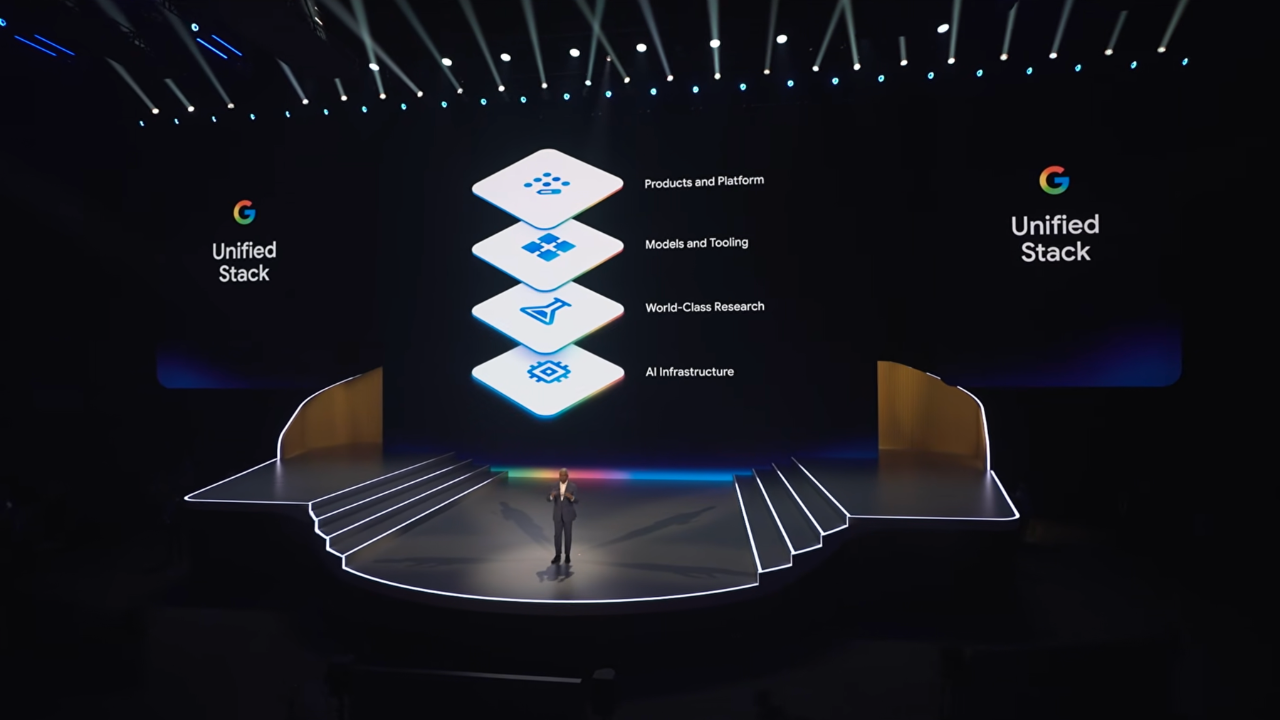
Thomas Kurian opened the week by telling enterprises that the pilot phase of AI is over. He framed Google’s pitch as owning the stack from chip to inbox while competitors hand customers pieces and ask them to assemble the platform themselves.
If that sounds like a tagline, you’re not wrong. But, if it is, it’s certainly not an empty one. Here’s what Google unveiled this week:
- Two new TPUs, the 8t and 8i, purpose-built for training and inference
- The new Gemini Enterprise Agent Platform, which sits on top of Gemini 3.1
- An Agentic Data Cloud that lets agents act on data wherever it lives
- Wiz, now formally part of an end-to-end security layer
- Workspace Intelligence, which pulls context across Docs, Sheets, Gmail, and Drive
- The new Virgo Network, the megascale data center fabric underneath all of it
Taken together, these announcements make it clear that Google is the only company in the conversation that designs the silicon, trains the model, operates the cloud, owns the data layer, and ships the productivity suite people already use every day.
“No other provider has all four of infrastructure, model, data platform, and distribution under one roof,” as Andi Gutmans, Google’s VP of Data Cloud, summarized on the showroom floor.
Owning the stack in this way is meaningful. Selling pieces of it with the understanding that some assembly is required creates friction for customers. Friction that costs time, breaks workflows, and burns through budgets.
That’s a meaningful bet to ask brands and businesses to make, and a hard one for anyone else to match right now.
Why this changes the competition
“Agent” and “AI” are rapidly becoming synonymous. And while providers who only own a slice of the stack are newly visible, Google Next demonstrated how stack ownership is starting to show its benefits.
The agent story at Microsoft, for example, still depends heavily on a model partner whose strategic interests are not always aligned with theirs. Nevertheless, they are continuing to win deals hand over fist. As is OpenAI, which, for all its momentum, does not own infrastructure at scale or a workplace distribution channel.
Meanwhile, Google Cloud closed its most recent quarter sitting on $240 billion of contracted work, up 55% sequentially and more than double the prior year.
As JPMorgan’s Doug Anmuth pointed out, Agents don’t just generate revenue; they make the relationship sticky. And, once an enterprise wires its workflows through an agent platform, ripping it out becomes far harder than swapping a model API.
The TL;DR? The model layer of agentic AI is becoming a commodity. The stack is becoming the moat.
Owning the stack is necessary, but not sufficient
Stack ownership matters. But for most CMOs, it is not the headline. What they want to know is simpler: Can this technology drive growth?
That is the question we keep hearing at DEPT®, too. Not which provider has the best demo, but who can turn these building blocks into outcomes that matter.
Marvin Chow, VP of Global Marketing at Google, captured it well when he said, “marketing engineers are the hire of 2026.”
“Marketing engineers are the hire of 2026.
”Marvin Chow, VP of Global Marketing at Google
Chow’s argument lands because knowing the tools is not the same as knowing how to make them work together. The teams that can do that will be the ones that create value.
That idea came up repeatedly in our conversations at Cloud Next, with both Google engineers and marketing leaders. It also echoed something we saw a decade ago, when Google first brought its cloud stack to market. At the time, many questioned whether it was as enterprise-ready as Azure or AWS. What those critics missed was that Google was already operating at massive scale across its own ecosystem, and we were there building alongside them.
As our experts look ahead to what the agentic era holds, our experience at Cloud Next validated a shared feeling: that this next phase of work demands a set of skills that blends marketing and engineering experience with practical knowledge of agentic AI.
So, now what?
The story coming out of Cloud Next 2026 is not about what separates Google’s agentic model from the rest. It’s that the advantages of owning an integrated stack are showing up at the exact moment the rest of the market is racing to commoditize the layer above.
For brands trying to figure out where to invest, the question they need to ask is not which partner, but rather how that partner can wire their stack to work that actually moves the business.
So where do you start? In our experience, the teams that get this right begin with the workflow. Pick one revenue or growth motion that has an obvious bottleneck. Map it end-to-end. Ask which step a well-designed agent could absorb, and which steps still need a human in the loop. Build something that addresses that bottleneck, measure it honestly, and use what you learn to fund the next one.
This is the discipline we have been formalizing inside DEPT®, building on our Growth Invention Framework to give clients a repeatable way to identify, prototype, and scale agentic work. The brands that do this right are the ones we believe will shape the next decade.