

Why more content isn’t fixing performance marketing


The following insight is adapted from DEPT’s Adobe Summit 2026 session, When Performance Creative Stops Performing (S738), presented by Jonathan Whiteside, Global EVP, Technology at DEPT®, and Gagan Mand, Director, Product Marketing, Digital Experience at Adobe.
Most brands hitting a performance ceiling assume they have a creative problem.
They don’t. They have a system problem, and pouring more content into a broken system makes it worse.
The symptom is familiar. Output is up. Channels are fed. Audiences are segmented to the millimeter. And still the curves flatten. The instinct, almost always, is to brief more, produce more, ship more.
That instinct is understandable, but ineffective.
Audiences fatigue faster than the system can respond
On Meta, the creative burnout window is now 14-21 days. For Reels, it can be as short as a week. Yet many teams are still working through the same sequence: brief, concept, produce, approve, localize, traffic. By the time the next wave lands, the audience has already moved on.
Demand is climbing too. Across DEPT, 62% of teams are handling twice as much request volume as they did a year ago. That is the reality many marketers operate in, with a shorter creative shelf life, greater demand, and the same underlying system still expected to keep pace.
-
62%
Of teams are handling twice as many requests
-
14 days
Creative decay on Meta
-
1 week
Creative decay on Reels
The bottleneck is everything around the idea, not the idea itself
Here is the unglamorous truth. Your most expensive creative people are spending around 70% of their time on work that requires none of their creativity:
- Resizing and reformatting
- Versioning and localization
- File hunting and approval routing
- Compliance checks and manual reporting
When the people who should be making the work are doing the admin around it, performance doesn’t fail because of talent. It fails because of design.
More content isn’t the answer. Better throughput is.
Volume can’t outrun a broken operating model. If anything, more output exposes the cracks faster – more rework, more rounds, more bottlenecks, more sameness.
Sameness is the second trap. Scale through templating, and distinctiveness erodes. You ship six ads, but they read as one. Efficiency at the cost of recognisability isn’t a win.
The brands that compound use structure to move faster without hollowing out the things that make them recognizable, e.g., tone, signal, character. Brand quality at speed, not sameness at scale.
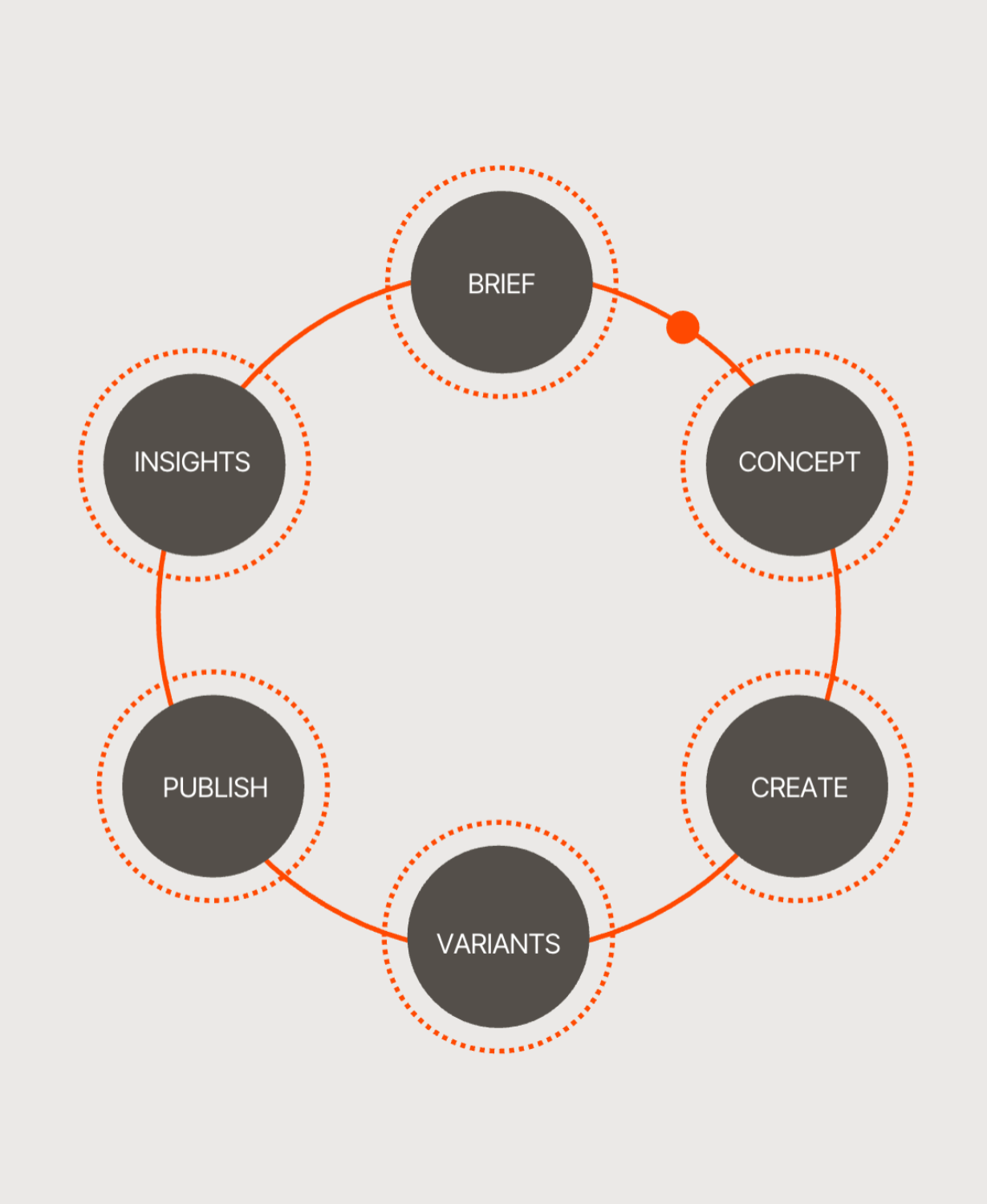
The real edge is learning velocity
Most organizations still run creative, media, and analytics as a relay race. Creative makes the work. Media launches it. Insights arrive later, often too late to shape the next round of decisions.
The model that compounds works differently. Performance signals feed directly back into the next brief, the next concept, and the next set of variants. Insight is not the end of the campaign. It is the start of the next cycle.
The feedback loop is the product. Everything else is production.
Tech alone won’t fix it
AI and generative tooling will dramatically increase output. They will not fix a fragmented operating model. If approvals crawl, ownership is fuzzy, and creative talent is buried in admin, faster tools just expose the bottlenecks sooner.
The real question for leaders is no longer “What can we generate?” It’s “How does work actually move – and where does it get stuck?” That’s a design question, not a tooling one.
At DEPT, we think about modern performance systems not as content engines in isolation, but as operating models that connect creative, media, data, and technology more effectively. That is also where our work with platforms like Adobe becomes practical, helping brands close the gap between faster content production and meaningful business outcomes.
What to do now
Stop asking “how do we get more content out?” Start asking, “Why is it so hard to get good content into the market in the first place?”
- If creative burns out in two weeks, refresh has to be built into the system – not bolted on.
- If demand has doubled, the workflow has to halve.
- If your best people spend 70% of their time on non-creative work, the issue is design, not capacity.
Performance marketing is a system to improve, not a content machine to feed. When performance creative stops performing, the fix is rarely to make more. It’s to build a better way of working.