
How Uber Eats already won the Super Bowl

There used to be a clean line in Super Bowl advertising: you made the spot, you guarded it like state secrets, and you unleashed it on game day like a fireworks finale.
But that line is gone.
Super Bowl LX is proving what many marketers have felt for the last few years but couldn’t quite put into words: the broadcast isn’t the main stage anymore. The pre-game is. And “pre-game,” in 2026, isn’t a weekend. It’s a three-week occupation that starts the minute the NFL playoff picture tightens and ends when the ball goes up on February 8th.
In a media world built on fractured attention and endless scroll, the $8 million 30-second spot isn’t really buying airtime. It’s buying entry into a narrative ecosystem: one you have to build early, feed constantly, and land on game day. Think of it less like a commercial and more like a season finale. If you didn’t watch the episodes leading up to it, you don’t get the full payoff.
The funnel that matters now: Teaser-to-tail
Here’s the shift: the best campaigns are creating a universe that people want to live inside before game day.
That’s partly because the Super Bowl has become the rare time mass audiences still show up together. But also because a meaningful chunk of viewers are there for the ads. In fact, the research points to a wild stat: 26% of fans say commercials are their favorite reason for tuning in, now outpacing the halftime show as the main draw.
When ads are the content, the brands that win are the ones who understand the psychology: attention is earned in advance, and memory is built through repetition, story, and emotion. Not just jokes.
This year, five brands have given us a pretty clean menu of modern approaches: Uber Eats, Budweiser, Dunkin’, Pepsi, and State Farm.
Uber Eats: A living, breathing conspiracy
If you want the clearest example of “Narrative expansion,” look at Uber Eats. This is year six for them, and their Super Bowl presence is a recurring franchise.
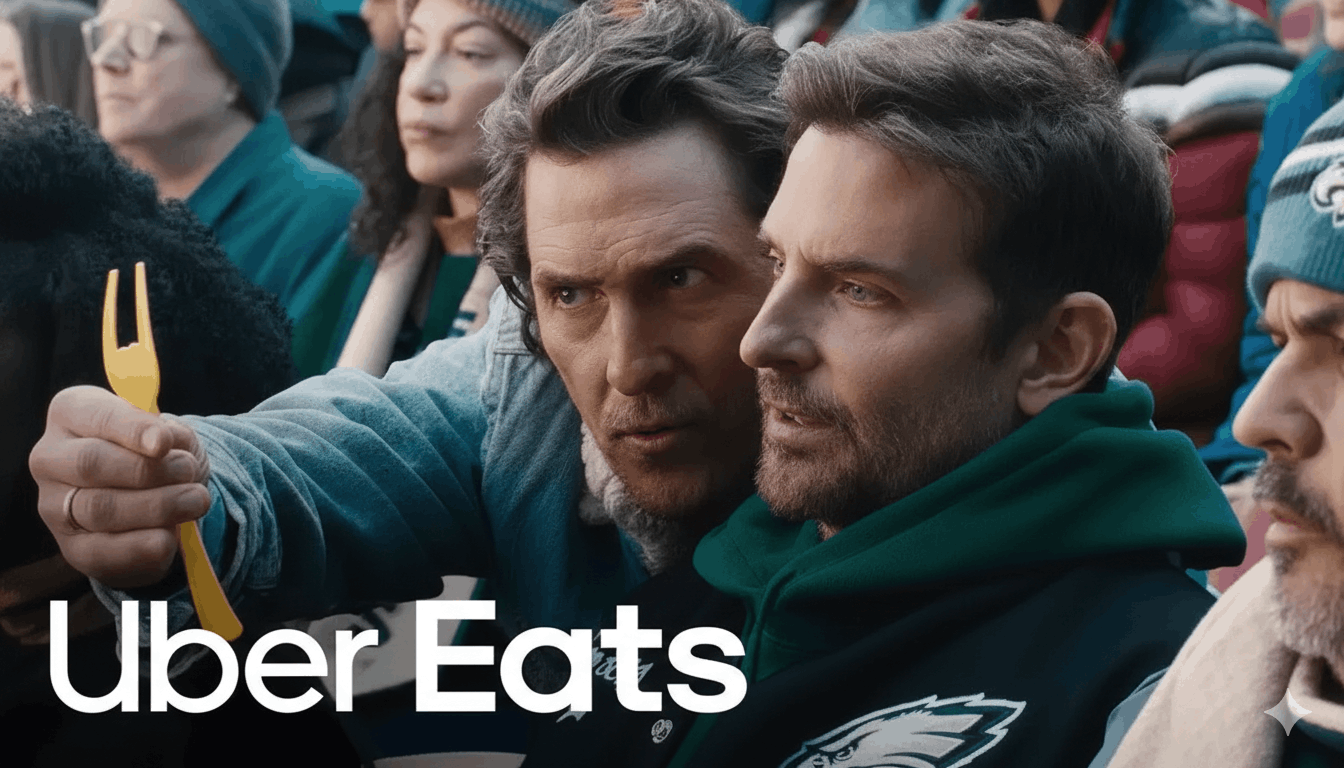
They took last year’s absurdist premise (football was invented to sell food) and escalated it. Football Conspiracy: “Football is for Food” becomes a character-driven feud: Matthew McConaughey as the committed theorist, Bradley Cooper as the skeptical foil, Parker Posey rounding out the vibe, plus the little jolt of nostalgia from a “Dazed and Confused” orbit that makes the casting feel strangely inevitable.
But the real power move is the structure.
Uber Eats used the AFC Championship window like a launchpad, dropping multiple teasers that all reinforced the same cognitive association: football words = food. “Pigskin.” “Scramble.” “Turnover.” Every time a viewer thinks of sports, they get yanked toward cravings.
Budweiser: A full reveal built for the heart, not the algo
Budweiser went in the opposite direction and did it with confidence.
Instead of dripping out mystery, they played “Full Reveal,” dropping the entire 60-second spot early (January 26) and letting emotion do the heavy lifting. 150th anniversary, heritage cues, Clydesdales, a bald eagle chick, “Free Bird” swelling in the background. It’s not subtle. And that’s the point.
In a cycle where so many brands chase weird-for-weird’s-sake or humor that evaporates by the next scroll, Budweiser chose stability and familiarity. A message designed to feel like a classic the second you see it, so that on game day, the audience greets it like an old friend, not a stranger asking for attention.
Dunkin’: Mystery as a search engine strategy
Dunkin’ took the “Mystery/Nostalgia” archetype and built it like a second-screen trap.
The VHS tape motif is basically a metaphor for the internet itself: someone teases a thing you can’t see, and your brain immediately goes, wait, what’s on it? The campaign leans into sitcom-era familiarity (Jennifer Aniston, Matt LeBlanc, Jason Alexander) and frames the whole thing as a lost 1995 “cringe” network pilot pitched by Ben Affleck.
Smart pivot, too. They moved away from the “DunKings” spectacle and into character comedy: something that plays better in teasers and thrives on speculation. Launching during the Grammys is the kind of placement strategy that marketers should study: adjacent audience, different emotional context, broader social footprint.
Pepsi & State Farm: Feuds, rivals, and competitive logic
By playing with the “Pepsi Paradox” and giving the Coca-Cola polar bear an “identity crisis” after choosing Pepsi Zero Sugar, Pepsi is basically turning brand rivalry into entertainment. Therapy scenes, community, and playful aggression are engineered for sharing and real-time social sparring.
State Farm, meanwhile, went with “Let’s feud,” with Danny McBride and Keegan-Michael Key as slacking agents selling “Halfway There Insurance.” A premise built for a month-long runway, anchored in the conference championships, and designed to ladder up into a longer storyline about what “real coverage” looks like.
The metric that matters is memory
Here’s what the data keeps whispering: humor might be the most common ingredient, but it isn’t the strongest one. Creative effectiveness platforms that measure attention and emotional intensity show that spectacle and nostalgia tend to hit harder.
That’s why you see high scores clustering around concepts like “hero moments,” comfort food romance, and emotional storytelling, not just punchlines.
And it’s also why 2026 feels like a reaction to 2025, a year that leaned heavily on amusement while being labeled one of the least effective Super Bowl ad cycles since 2020. Brands aren’t abandoning comedy, but they’re padding it with something sturdier: meaning, craft, story structure, or controversy.
So, who won the pre-game?
If you define “winning” as owning the conversation before kickoff, it’s Uber Eats.
Budweiser arguably won the heart. Dunkin’ won the click. Pepsi won the rivalry lane. State Farm built a clean campaign runway.
But Uber Eats did the hardest thing: they made the ad feel like entertainment with continuity and a sequel people are already tracking, debating, and repeating in their heads. They combined championship dominance (reach), social noise (conversation), and emotional stickiness (memory) into one machine.
And they proved the modern truth of “The big game” advertising: the spot isn’t the point.
The point is everything you build around it — the breadcrumbs, the chapters, the feuds, the reveals, the arguments online, the search spikes, the second-screen behavior, the moments that make people say, wait, I’ve seen this… what’s next?