

The orchestration era: When data, workflow, and culture meet


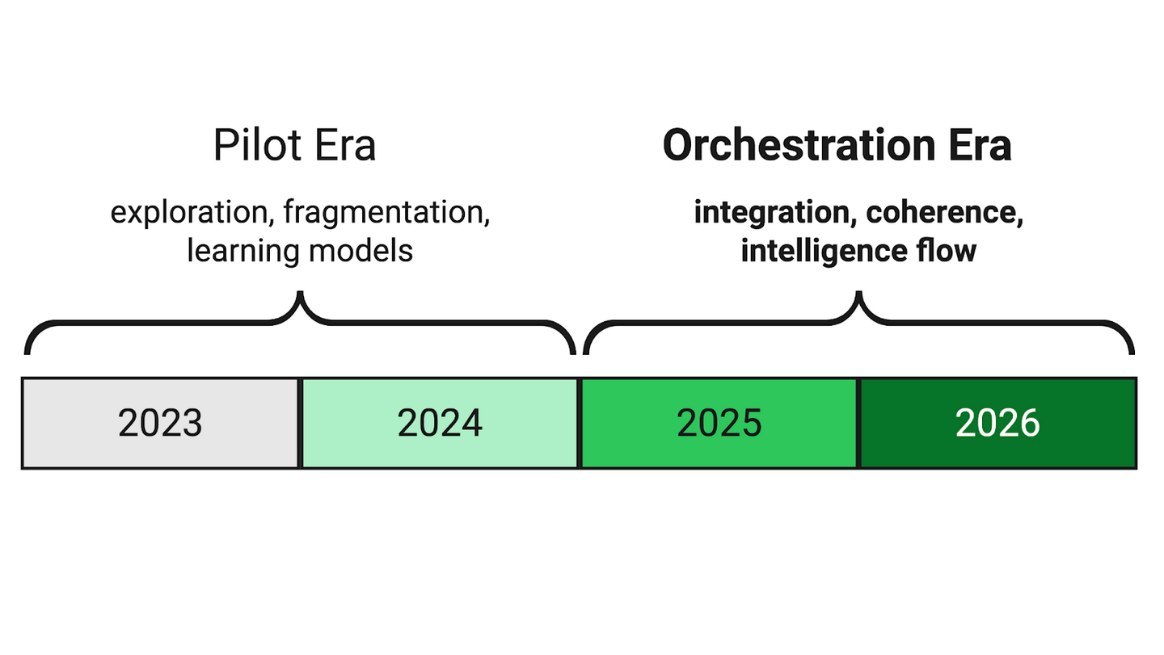
A few years ago, most organizations were experimenting with AI: testing prompts, trying small workflow shortcuts, and running low-stakes pilots.
It was the right approach at the time. Pilots offered a safe way to learn what AI could and couldn’t do and where it might fit.
But the context has changed. AI is no longer a novelty or a side experiment. It’s a core capability with measurable impact across marketing, operations, finance, product, and customer experience. The question inside leadership teams is no longer Should we be using AI? It’s How do we scale this across the business?
The challenge is that most pilots weren’t designed to scale. They live in isolation and generate value in pockets, but sit outside the systems and workflows that support enterprise change. They teach but don’t transform.
At the same time, the nature of AI has shifted. Models are now powerful enough that the limiting factor often isn’t the technology but the organization around it. Small experiments can validate ideas, but they don’t create coordinated, cross-functional impact. Staying in “experiment mode” now carries an opportunity cost.
If first-generation AI was about curiosity and second-generation AI was about testing and uncovering efficiencies, the third generation is about effectiveness and using AI to make the whole organization smarter, faster, and more in sync—ultimately capturing AI’s compounding ROI. This is the orchestration era, in which progress depends less on isolated tests and more on how effectively intelligence can move and scale through the enterprise.
Why pilots fall short
Across industries, AI pilots rarely fail because the models underperform. They fail because the surrounding organization isn’t prepared to support intelligence at scale. Pilots sit outside the governance, workflows, and data structures that hold the business together, making them quick to launch but difficult to sustain.
The numbers back this up. In one IBM study, the top barriers to scaling AI weren’t about accuracy or model performance. They were about the fundamentals:
- 48% cited data governance as the primary blocker
- 39% cited lack of integration with existing systems
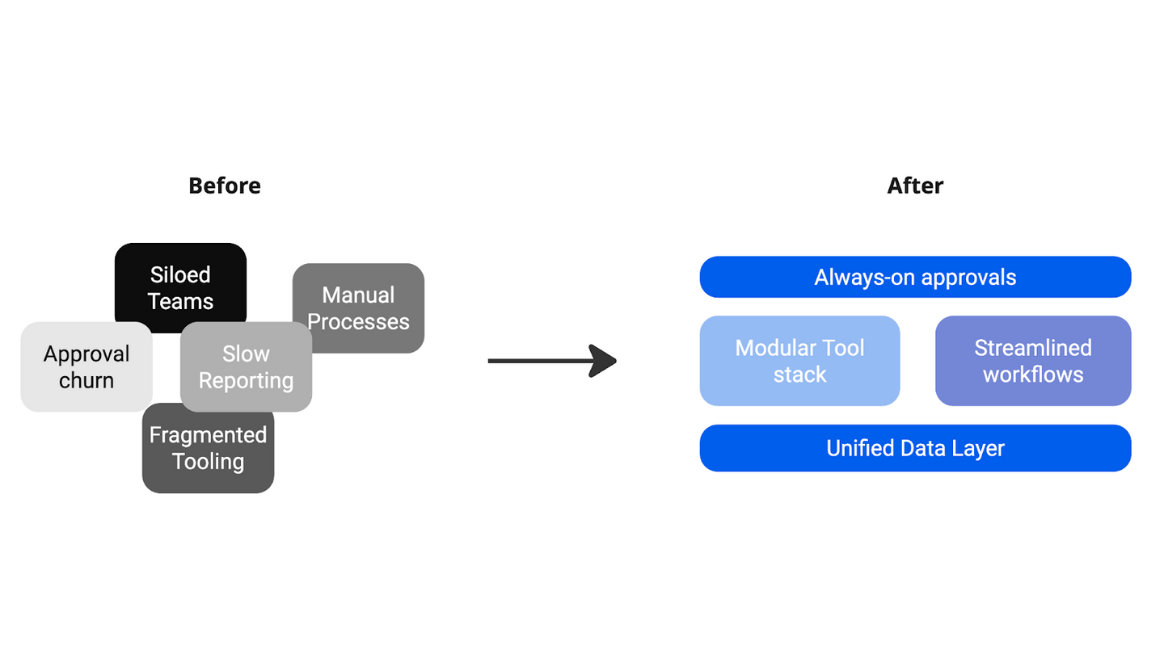
Most organizations still operate with siloed data, disconnected tools, and bespoke processes. A pilot can succeed on its own terms yet fail to create enterprise value because nothing around it is designed to amplify or absorb it.
Third-generation AI thinking clarifies why. AI only learns from what it can see; fragmented data produces fragmented intelligence. Undefined workflows limit automation. And even strong solutions stall when teams aren’t equipped to use them.
Pilots offer control, but transformation requires connection—integrated systems, unified data, and processes that allow intelligence to move across teams and decisions.
The real work: designing, not just proving, intelligence
The focus now needs to shift from adding new tools to designing the systems, workflows, and structures that allow intelligence to move through the business. Progress starts with understanding where data lives, how teams collaborate, and which processes create friction, and then shaping an environment where AI can reliably support that work.
A few principles consistently help organizations move forward:
- Connect core data. AI improves when it can see a complete picture. Consolidating sources of truth and improving data hygiene leads to more accurate, usable outputs.
- Simplify workflows before automating them. Clear, repeatable processes help AI slot in without adding confusion. This often reveals duplicate steps or inefficient handoffs worth removing.
- Build where it differentiates; partner where it accelerates. Proprietary data or unique workflows often warrant in-house capability. For everything else, existing platforms speed up adoption.
- Support teams through the transition. Clear expectations and early wins make adoption smoother and help teams understand where the tools add value.
When data, workflows, and team behavior are aligned, improvements reinforce one another. Integrations become easier, automation becomes more consistent, and opportunities become clearer. Momentum builds because the organization is designed to absorb and apply intelligence rather than work around it.
A path for integrating intelligence at scale
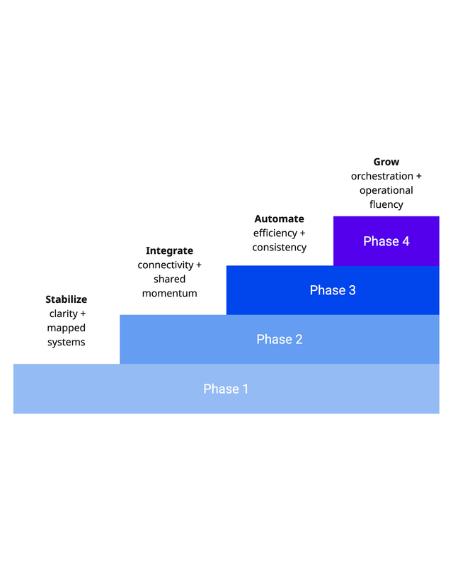
Moving beyond pilots doesn’t require a dramatic overhaul. Incremental, phased progress reduces risk, builds momentum, and creates conditions in which intelligence can circulate across the business.
Phase 1: Stabilize — set the foundation
Map systems, clarify data ownership, document key workflows, and address obvious bottlenecks. The goal is to create a stable environment where new intelligence won’t introduce disruption.
Phase 2: Integrate — connect systems and simplify workflows
Link the data sources, tools, and teams that drive the most immediate value. Early integrations act as proof points and establish the architecture for intelligence to flow beyond isolated use cases.
Phase 3: Automate — turn consistency into scale
With cleaner workflows and connected systems, automation can reliably improve speed and accuracy. Automating repetitive tasks frees teams to focus on higher-value work and reinforces consistency.
Phase 4: Grow — embed intelligence into daily operations
As processes align and data become more consistent, AI begins supporting day-to-day decisions. This creates what we call operational fluency, or the ability to absorb new information and act on it quickly and confidently.
These phases form a repeatable cycle. Each step strengthens the next, making it easier to introduce new capabilities without disrupting existing work.
Measuring progress: operational fluency indicators
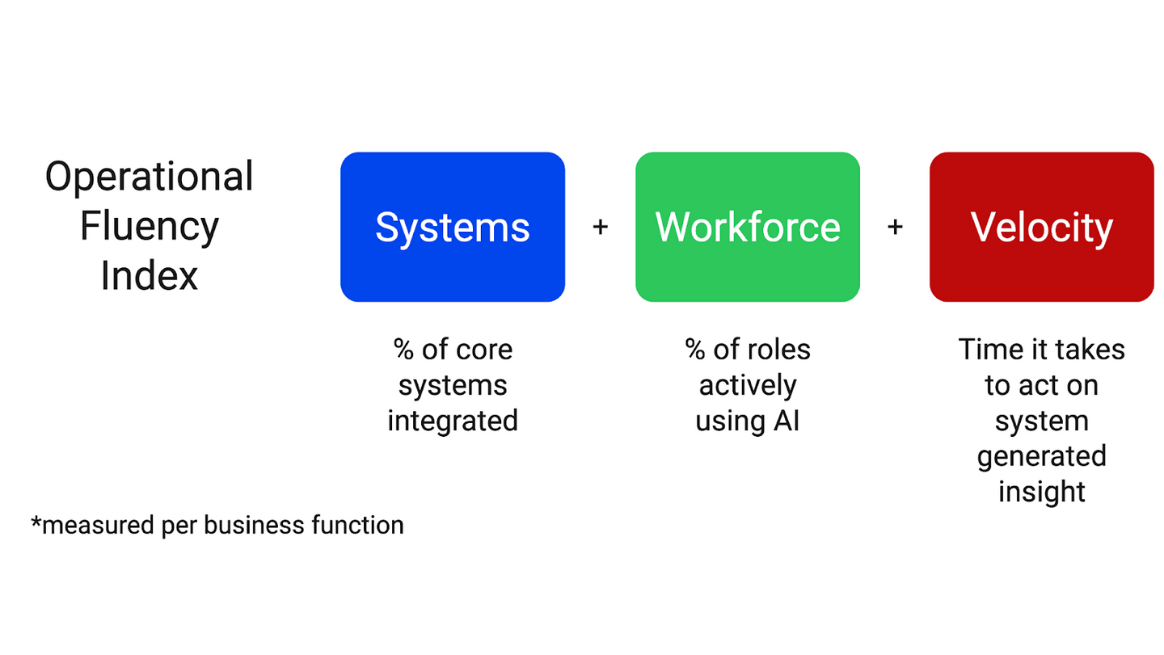
As organizations move through these phases, they typically improve across three dimensions that together signal how well intelligence can circulate:
- System connectivity: Key platforms and data sources are linked, reducing manual work and inconsistencies.
- Workforce proficiency: Teams understand how AI fits into their workflows and feel comfortable relying on it.
- Insight-to-action velocity: The time between receiving an insight and acting on it decreases as processes become clearer and more predictable.
These indicators don’t need to be perfect; they simply need to trend in the right direction. As they do, each improvement reinforces the next. Better data quality strengthens automation, clearer workflows speed decision-making, and increased team proficiency creates capacity for additional transformation.
The result is a compounding effect: intelligence becomes easier to introduce, easier to scale, and more valuable across the organization.
Designing for coherence, choosing where to differentiate
As organizations enter the orchestration era, a common question is whether to build capabilities in-house or buy off-the-shelf solutions. The most successful transformations take a balanced approach:
- Build when the capability depends on proprietary data or offers a meaningful competitive advantage.
- Buy when speed, reliability, and proven functionality matter more than customization.
What unites both paths is the need for coherence. Whether a solution is built or bought, it must fit into an integrated architecture where data moves cleanly, workflows are clear, and teams know how to use the tools available to them. Without that alignment, even the best technology underperforms.
The opportunity ahead is straightforward: organizations that invest in stability, integration, and clarity—not just experimentation—will scale AI more predictably and more profitably. Pilots helped us understand what’s possible. Third-generation AI orchestration is how organizations turn that possibility into durable, compounding impact.