
A different take on the burger bite seen ’round the world

A few seconds. One tiny bite.
And suddenly, a CEO taste test became a cultural moment.
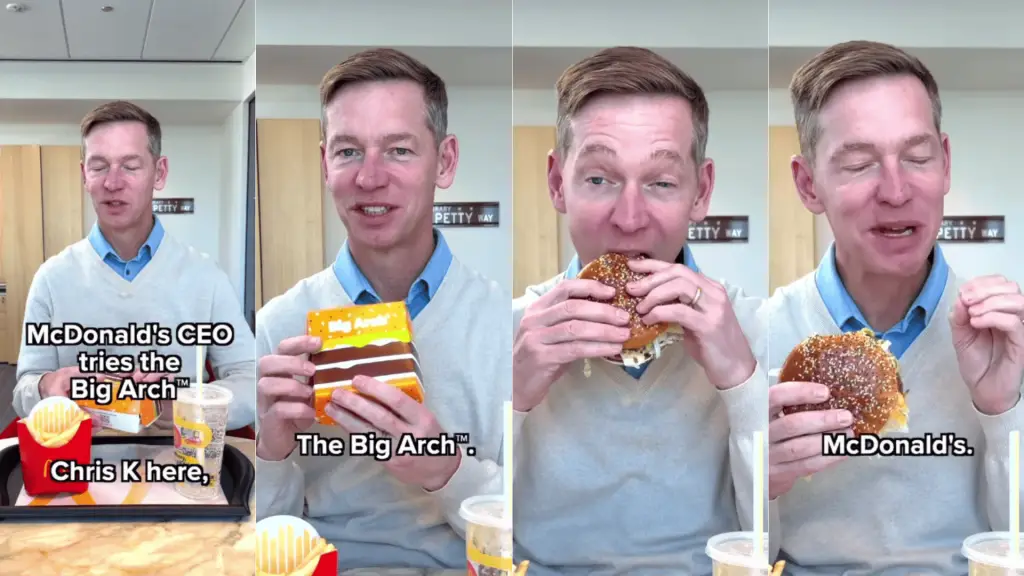
If you missed it: McDonald’s CEO Chris Kempczinski posted a video promoting the new Big Arch Burger. The internet latched onto his stiff delivery, his use of the word “product,” and most memorably, a very small first bite. TikTok did what TikTok does: parody, remix, roast.
The easy takeaway is “don’t let execs do social.” But that’s not the most useful lesson here. Because honestly? The video wasn’t that awful. It had a dad-tryna-do-social awkwardness that can read as….actually pretty endearing.
The bigger story is what the reaction reveals about how people currently feel about McDonald’s and how quickly audiences seize on a single moment as proof of a pre-existing belief.
This wasn’t a content problem. It was a credibility problem.
In a vacuum, the clip is just a corporate leader doing a slightly wooden product promo. But brands don’t live in vacuums. They live inside the narratives people carry around.
For many consumers right now, McDonald’s sits in a mental category that looks something like: corporate, convenience-first, optimized. Not a food company obsessed with making delicious food. When that’s your starting assumption, the CEO calling lunch a “product” doesn’t come across as harmless internal jargon. It’s confirmation.
So when the internet piled on, it wasn’t only judging this single video. It was judging whether McDonald’s still feels like the kind of brand that can credibly talk about food with genuine delight.
Burger King did something smarter than clap back
Burger King’s response landed because it was culturally native and earned.
Instead of an office vibe and ingredient narration, BK’s video leaned into proof with quick visuals, a test-kitchen feel, and the climactic shot everyone was waiting for—an intentional, enthusiastic, big bite of the Whopper. Even the tone stayed playful with BK’s CEO saying, “Only one thing missing — a napkin.”
That matters because in competitive moments, audiences aren’t only measuring wit. They’re measuring credibility. Burger King has a long history of directly challenging McDonald’s, so this didn’t feel like random opportunism. It felt on-brand and sharp, but not mean.
The first credible responder usually gets the cleanest contrast. But once a moment becomes a ‘format,’ latecomers can still earn attention if they bring a distinct POV that’s already believable for their brand. Now that Wendy’s and A&W have entered the chat, the moment has shifted from a two-brand dunk-fest into a broader credibility contest.
You can’t content your way out of a credibility deficit
A lot of post-mortems on moments like this focus on craft: better script, better setting, better edit, better media training.
Sure, those things help. But they’re not the root cause of this viral moment, because when a brand’s credibility is strong, even imperfect content can land as human. But when credibility is weak, even polished content can feel like performance. The internet isn’t only watching what you post. It’s watching whether your brand has earned the benefit of the doubt.
That’s why this moment is more interesting than “cringe CEO video.” It’s a reminder that brand perception is more than background noise. It’s the headline.
What brands can learn (Beyond “don’t be cringe”)
This moment offers a cleaner playbook than most viral marketing lists:
1) Treat virality as a diagnostic, not a dunk. If a moment randomly becomes a roast, ask what pre-existing belief it activated. What story did the audience already have loaded?
2) Rebuild credibility with receipts, not rhetoric. If you want to be perceived as a food brand (not a convenience brand), you need sustained proof: product decisions, quality signals, transparency, and values people can feel.
3) Use humor as a bridge, not a solution. Leaning into the joke can signal listening in the short term. But the long-term work is changing the story that made the joke land in the first place.
The bite seen ’round the world wasn’t really about a bite
It was about belief. And belief is the real battleground for brand trust. Because when trust is strong, even a dad-ish CEO moment can be endearing.
And when trust is weak? Even a burger becomes a product.