
Bigger catalogs or better conversations? The agentic advantage for Adobe Commerce brands


Today’s e-commerce journeys ask consumers to do a lot of the work: search, filter, compare, and repeat until they finally check out…or give up.
That model works when people know exactly what they want, but it often falls short when they need help deciding. Most customers do not think in catalog fields. They think in needs, tradeoffs, budgets, occasions, compatibility, and confidence.
Because of this, brands are exploring custom ChatGPT apps for conversational commerce. These apps let customers ask for what they actually mean, not what they think the site taxonomy expects.
For brands using Adobe Commerce, this adds a more natural shopping layer where customers can simply explain what they’re looking for and get helpful, grounded guidance, while still connecting to the same systems that manage catalog, pricing, promotions, checkout, and orders.
The real unlock is continuity
Many AI-powered commerce features start and stop with product discovery. It’s useful for shoppers at that stage in the buyer’s journey, but means brands are missing out on the bigger opportunity: continuity. When the same assistant can guide the shopper from first question to confirmed order, the experience stops being a novelty and starts becoming a true commerce channel.
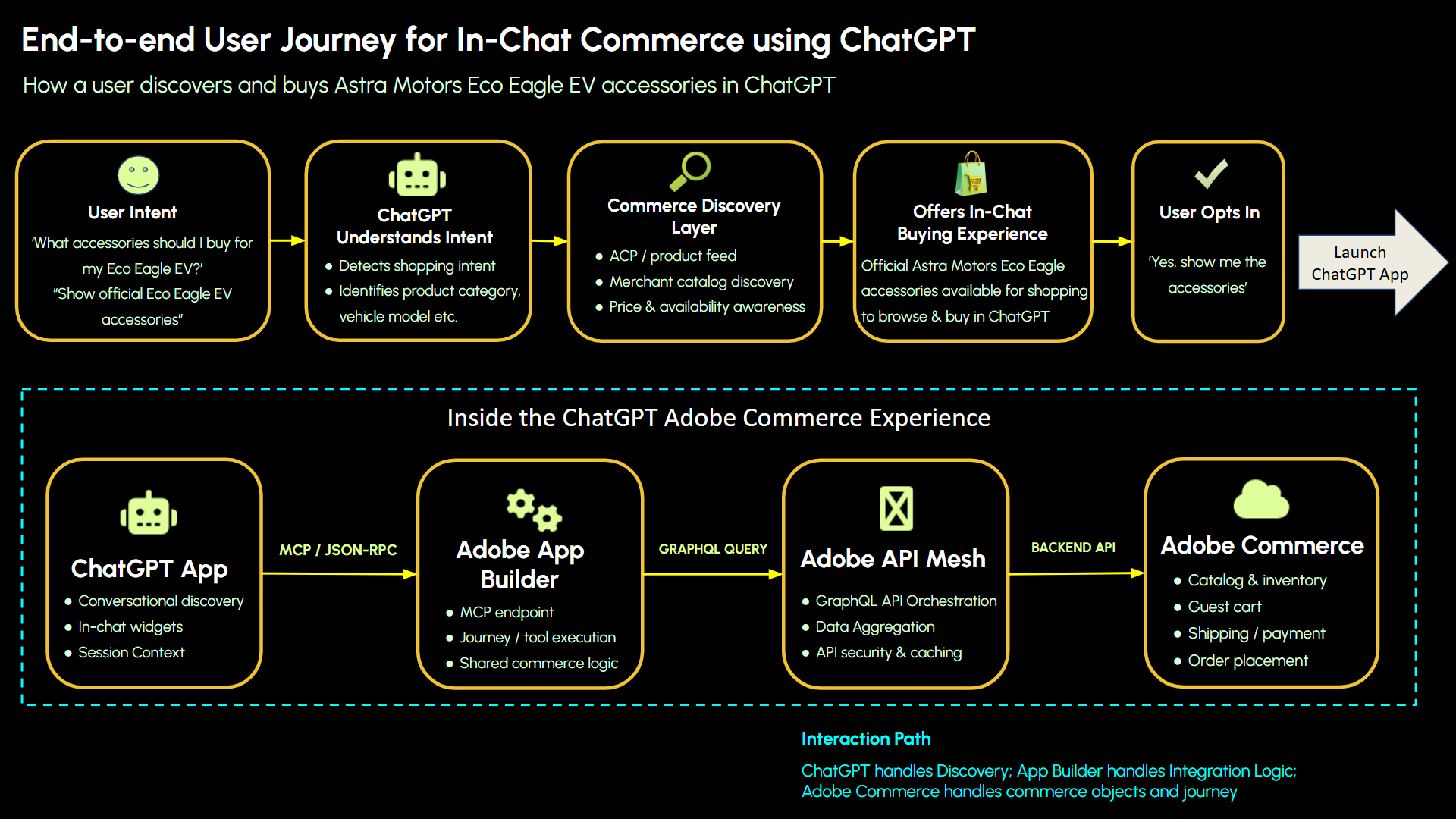
In the Adobe Commerce model we’ve built at DEPT®, the assistant can search products, build a cart, apply discounts, collect shopper details, show shipping and payment options, and place the order. Shoppers can start in ChatGPT using natural language, get grounded product results from Adobe Commerce, and continue through checkout without switching context. The result is fewer steps, less friction, and a real order confirmation inside ChatGPT.
Why the architecture matters
A commerce assistant is only useful if it can be trusted to act on accurate information. That requires a structured connection between the conversational interface (i.e., ChatGPT) and the commerce systems responsible for product data, pricing, inventory, cart, checkout, payment, and order management.
In this model, Adobe Commerce remains the source of truth. It holds the live commerce data and transaction logic that the assistant needs to provide reliable guidance and complete real actions. Adobe App Builder acts as the execution layer, allowing teams to create secure actions that can search products, update carts, apply promotions, retrieve shipping options, and support checkout flows.
Model Context Protocol (MCP) gives the assistant a structured way to call those actions. Instead of relying on the model to improvise, MCP defines which tools are available, when they should be used, and how requests should be passed between the conversational interface and the commerce backend. API Mesh helps simplify and scale the integration layer by connecting Adobe Commerce and other backend services through a more consistent API surface.
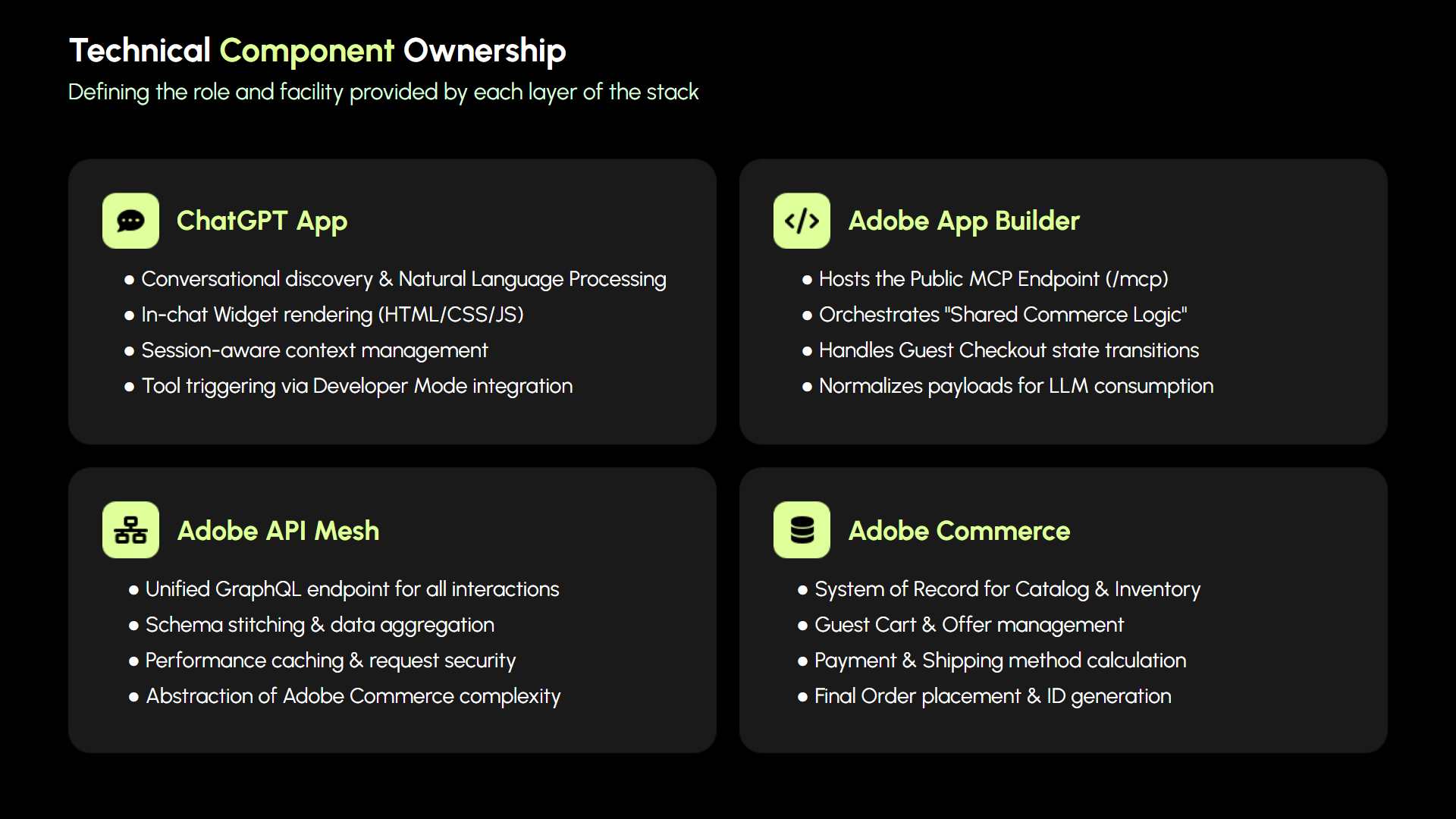
This structure separates an agentic commerce experience from a more traditional chatbot. The model can manage the conversation and interpret intent, but the commerce platform remains responsible for the data and the transaction. The assistant is not guessing whether a product is available, when a promotion applies, or if an order can be placed. It is calling governed commerce workflows designed to return accurate, usable answers.
As brands’ custom commerce apps expand beyond product discovery, it’s critical that the architecture supports security, reliability, governance, and scalability. The buying experience may feel like a casual conversation to shoppers, but the underlying system has to behave like enterprise commerce infrastructure.
What this changes for performance
When customers can naturally describe what they’re looking for and receive grounded recommendations, product discovery becomes faster and more relevant. When the same assistant can suggest add-ons, apply personalized promos, and handle checkout, the journey becomes easier to complete. And when that same connected layer can answer order status, return, exchange, or compatibility questions, it reduces the volume of repetitive support interactions.
The business upside comes from three areas:
- Higher-confidence conversion: Shoppers get clearer guidance before they abandon the journey or seek advice elsewhere.
- Smarter basket-building: Recommendations can support bundles, accessories, replenishment, upgrades, or cross-sells based on real product and cart context.
- Lower service burden: Common support questions around orders and returns can be handled through a more scalable self-service experience.
Just as importantly, these conversations create a new source for understanding customer intent. While search bar data shows what people typed, conversational data can reveal what they were trying to solve, where they hesitated, and what information they needed before making a decision.
From product question to completed order
Imagine a shopper exploring electric SUVs. Instead of navigating their local dealer’s website or comparing models on Kelley Blue Book, they start in ChatGPT with a specific question: “Which electric SUV would work best for family trips with strong range and a premium cabin?”
A commerce-connected assistant can interpret that intent, search the Adobe Commerce catalog, and return relevant product options grounded in live data. It can explain why one model may be a stronger fit over another, provide pros and cons, and answer follow-up questions. Then, rather than send the shopper back to a static site experience, the assistant can help them take the next logical step, such as checking local inventory, finding available trims, or scheduling a test drive.
A similar model can support e-commerce journeys in electronics, appliances, home goods, fashion, beauty, automotive, and any category where guidance plays a meaningful role in conversion.
Building the buying layer customers actually need
A custom ChatGPT app connected to Adobe Commerce through Adobe App Builder, MCP, and API Mesh gives brands a practical way to turn existing commerce infrastructure into a more helpful buying experience. The question is where it can create the most value first.
That answer will look different for every brand. Some will benefit most from guided product comparison. Others may see the clearest opportunity in fit, compatibility, bundles, promotion confusion, checkout support, order status, or returns. The best starting point is usually a stage of the journey where customers already need more guidance than the current experience provides.
For brands still working out where AI can have the biggest impact across their e-commerce, DEPT® can help identify the highest-value opportunities, design the right experience, and build the architecture to support it.
More AI, apps, and bots alone won’t create the next competitive advantage, but smarter, more contextual conversations will.